At the end of the year I'm considering transitioning all of my News/Views into a single format. This is anticipated to be available only by subscription via a weekly email as well as a private site (see end of this digest for more). Don't worry, the rest of the information on my current sites would remain free.
To give you an idea of what that a weekly digest might look like, I've again taken the past week's news and built it into what this week's email would have looked like under this new plan. Enjoy. (p.s. If you're interested in potentially subscribing, be sure to click here to receive further updates as this idea gets developed.)
--------------------
LEDE ON
We hadn't even hit Cyber Monday (today) and we've already learned that holiday online sales are up 9.4% compared to last year. That's US$8.6b spent online on Black Friday (at least up until 6:30pm EST). This data comes to us from Adobe Analytics, a part of the big company you love to hate but probably weren't aware of, which provides statistical and marketing insights and advice to a wide range of big corporate customers. Adobe also made forecasts for the full Black Friday, the Black Friday weekend, and Cyber Monday, all of which they say will be up and perhaps to record levels, but I'll wait until next week to tell you if those guesses were accurate.
--------------------
TECH
And now we have a new term to learn...
As part of Sony Semiconductor's announcement of a new smartphone sensor (200mp!), we got a new term introduced into the mainstream (it's been around in the labs for awhile): remosaic. The current term for deciphering a Bayer (or even other multicolored filter) sensors is demosaic. The Bayer pattern (RGGB) is a mosaic of individual colors, so you need to decipher and interpolate that mosaic to get pixel colors, so de-mosaic.
Okay, so what the heck is remosaic? Well, according to Sony that's when you take a set of binned, adjacent same color photosites and create a faux Bayer pattern for the individual photosites. Let me explain. The new sensor uses blocks of 16 adjacent photosites all under the same color filtration, but arranges those blocks in a 64 photosite block that's effectively Bayer:
GGGGRRRR
GGGGRRRR
GGGGRRRR
GGGGRRRR
BBBBGGGG
BBBBGGGG
BBBBGGGG
BBBBGGGG
etc.
But we want
GRGRGRGR
BGBGBGBG
GRGRGRGR
BGBGBGBG
.etc.
To get that, we have to remosaic, which involves interpolating an individual photosite's implied full color values from adjacent and near adjacent real single values.
But wait, if you buy today...
Sony Semiconductor is also preaching remosaic using AI (as opposed to up/down scaling, which was done in the past). Yep, this new image sensor has an AI as well as an ADC circuit onboard to do your remosaicing for you (which ironically, still needs to be demosaiced).
Fortunately, Sony Semiconductor avoided using the dreaded and argued about "resolution" word. Their terms were "improved reproduction of details" and "better image quality."
But wait, if you buy today...
The thing most other sites that covered this picked up on was the hybrid HR system, which effectively combines a "short" exposure to a photosite with the "full" exposure to a photosite that's then handled by the ACD via a dual gain conversion and combination. What this does is give you a "preserve the highlights" set of data that is combined with the eventual "full capture" set of data. We've had variations of this combinatorial approach before, most notably Fujifilm's SR sensors, and we've had some simultaneous dual gain conversions recently (Pansonic's use of the partially stacked 24mp image sensor), but this is the first time we've seen it integrated at the photosite cell level, I believe.
What I object to are the posters claiming that dynamic range is extended using this technique (Sony claims over 16 stops). Realistically, the two exposures are being combined, so you're compressing an expanded dynamic range capture into the same final bits, and how you do that becomes very important, because the results are no longer linear, and totally under control of the image sensor technology. Previous attempts at this have all had a side effect of looking really good for some scenes, and less good for others.
--------------------
Camera
Sony completes the cycle
Canon, Nikon, Panasonic, and now Sony have now all introduced their sub-US$3000 model updates that bring a key older model into their current generation designs (e.g. Canon R6 Mark III, Nikon Z6III, Panasonic S1II, and Sony A7 Mark V).
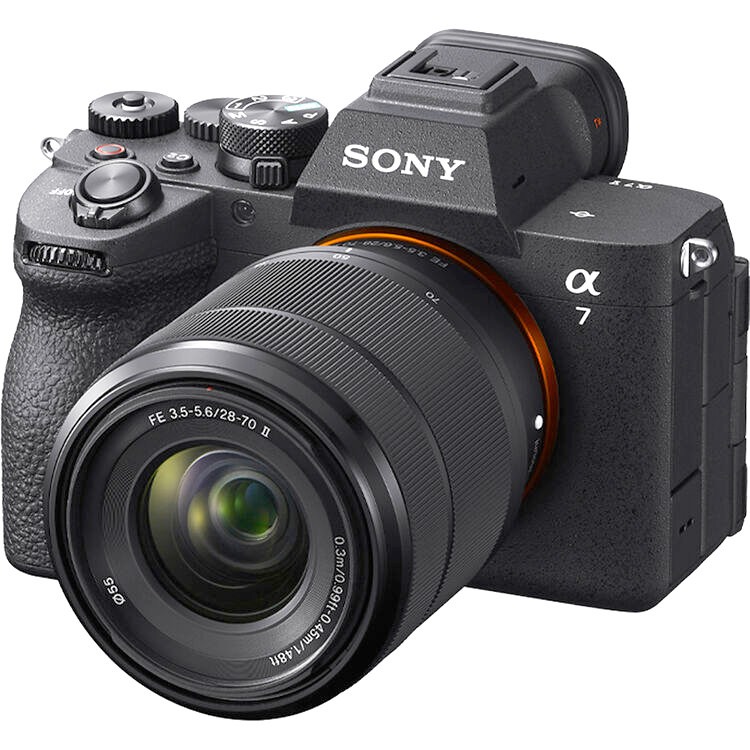
One interesting thing to this story is that Sony dropped a major firmware update for the A7 Mark IV (and A7R Mark V) just prior to showing the new camera. By major, I mean additions and changes to the focus system, new video workflow, improvements to FTP transfers, vertical information overlays, a Golden Ratio grid, new button customizations, image authentication, as well as the usual bug fixes and stability improvements.
To me, this says that Sony is going to keep selling the Mark IV alongside the Mark V for awhile. But it also means that to get significant new upgrade/update sales from their users, the Mark V needs some distinguishing traits of its own, so let's get to that...
Let's start with what a Sony A7 Mark V is and isn't. At first glance, many things appear the same as the four-year old Mark IV: 33mp image sensor, 4K/60P no crop, and a body design that looks mostly the same. However, that image sensor has been updated to be partially stacked, which changes a number of key features. We now have 30 fps 14-bit raw as well as pre-capture on the still side. On the video side we now have 4K/120P (cropped), and a better 4K/60P, but we don't get 6K, Open Gate, or raw video. The IBIS platform on which the sensor sits now provides up to 8 stops of stabilization (up from 5.5). The BIONZ side of things now gets an AI addition, much like the top end Sony cameras.
Some of the physical bits remain the same. The EVF is still 3.69m dot. We still have dual card slots with one being CFexpress Type A or SD, and the other being just SD. But some of the hardware has been upgraded: the Rear LCD gets a tilt mechanism to go with its articulation, and the Mark V now has two USB-C ports.
The first question that gets asked is "should I upgrade from my Sony Mark IV model?" Generally, I've long held that if you're sticking with a particular model in a brand lineup, you should skip updates (e.g. update from version 1 to version 3, but not 2). So I'd normally say Mark III users should look carefully, but Mark IV owners should be more skeptical of upgrading. In this current round of mid-level mirrorless bodies, though, there's been some pretty big moves, so I wouldn't fault you if you saw the increased performance as being worth getting out your credit card again. One thing that should be considered though is that you won't really get better image quality (though if the improved focus and IS systems work better for you, you might get better images, just not really better pixel quality). You'd be buying for features and specific performance benefits.
So let's discuss the current entrants in this category. The Nikon Z6III is now the oldest at just a bit over a year old. Panasonic's S1II is only six months old, Canon's R6 Mark III is barely a month old, while Sony has the newest camera in the group. On thing that's happened in this round of updates is that we're now a long ways from the old US$2000 prices that earlier versions of these cameras were selling at. The Nikon lists for US$2500, and the new Sony is US$2900. The Panasonic is actually the priciest at a list price of US$3200.
The first thing you're probably asking is whether 24mp (Nikon, Panasonic) is now outdated. No. 33mp really only gives you about a 3" bigger print size overall (e.g. 23" instead of 20"). Almost no one can distinguish that minimal increase in resolution. In terms of dynamic range, the Panasonic is best at ISO 100 due to the unique way in which it manages the dual gain system, but that's still only perhaps a stop better than the worst player at ISO 100, and that advantage disappears as you boost ISO. I will say that the electronic shutter on the Canon shows clear noise degradation that the others don't (though I haven't tested the Sony on that yet). Still, all the image quality parameters basically work out to be similar enough not to be a real consideration in which model to buy.
Yes, on the video side there are some differences in how things are handled if you need more than 4K/60P using H.265 (10-bit 4:2:2). The new Sony doesn't do Open Gate or 6K, for instance. But how many of you are buying this level of camera to do top-end video (and Nikon's lower cost ZR suddenly makes a case for considering it instead, as it does clearly better 6K raw video than I've seen from anyone else at anywhere less than double the prices of the ZR).
It doesn't even fall to unique features any more. Everyone does pre-capture now. All buffers are now adequate. The EVFs are excellent (though Canon's still lags a bit). Perhaps you can find some differences in pixel shift, focus shift, or multiple image capabilities, but those are pretty esoteric features not used by all that many.
Which brings us to where we were in the DSLR era: stick with the brand you know. The way the naming, UI, and physical controls work is unique to each brand. As I've written for years: you will miss photos if you're still working through the cognitive dissonances of changing brands. Chasing marginal gains by switching brands as you update/upgrade tends to be counterproductive.
So for Sony users at least, we're back to the question I mentioned earlier: "should you upgrade from the Mark IV model?" If you're a casual photographer who doesn't press their camera to the max, the answer is a fairly clear no. You've got a really competent camera already. If you're really pressing the focus system or the continuous frame rate, okay, it's worth taking a look at the new Mark V. But I'm not seeing a lot in between that would justify the expense of moving to the new model, particularly since the used value of the Mark IV has been plummeting.
Finally, there's this: why introduce a new camera on December 2nd? Dealers loaded up their holiday inventory (and committed their cash) prior to November's early Black Friday promotions. Multiple dealers I talked to didn't even know when the Mark V was going to be announced until the first teaser dropped on November 26th. Trying to squeeze in a limited shipment before the end of the year is either (1) "we're late and we needed those sales to meet quarterly numbers"; or (2) "oh no, Canon dropped the R6 Mark III for the holidays and all we have is a four-year old camera." Perhaps both. Waiting until CES on January 6th would have been a way to make a bigger, more visible launch, and out of all the holiday sales noise.
--------------------
First Impression
The new DX normal
Nikon's recent drop of two new DX lenses for the Z-mount certainly seems to have changed things for the small sensor users. While neither are S lenses, it's unclear that 20mp DX camera bodies actually need superlative optics, just very good ones.

And the 35mm f/1.7 DX (effectively 52.5mm) turns out to be a darned good one with a nice added benefit. That added benefit is 1:2 near macro focusing capability (see example: as you can tell, at really close distances and f/1.7, there's not much depth of field ["que vous" is what I focused on]).
In terms of chart testing, the new lens is surprisingly close in MTF values from center to edge, even wide open. The numbers aren't startling wide open, but certainly good. My first pass observation is that at f/2.8 you get the best performance out of this lens, with almost nothing to complain about. The f/1.7 and f/2.0 results are lower mostly due to coma and a bit of chromatic aberration, but show the same near evenness of sharpness across the frame.
I'm liking this new prime better than the previous (24mm f/1.7 DX), though be aware that the 35mm lens is substantively longer physically. Reviews coming in early 2026.
------------
My apologies to those you who've tried to sign up for updates (see below) but had their email address rejected for some reason. This is being looked into.
Congratulations on making it this far. As you can see, this weekly "newsletter" style for News/Views can be quite elaborate and lengthy, particularly once I add in video instruction and other planned items. The fact that it will be sent (mostly) weekly would be part of its benefit: you wouldn't have to scroll all my sites daily to find what I might have written, because you've subscribed for everything to come directly to your email InBox as it gets published each week. By putting everything in one spot, in a single format, it also saves me time.
My current intention is to remove News/Views from all but the zsystemuser.com site (where you'll still get shorter, one or two paragraph news items about the latest Z offerings), to remove all ads and affiliate links from my sites, and generate on-going revenue through modest subscription fees that include the weekly News/Commentary newsletter, ongoing video instruction/presentations, monthly hangouts, and more. I call this new thing byThom Max, because I'll be on maximum while doing it, including going to and reporting from as many of the trade shows I can, as well as other events, covering them for the newsletter.
I'll have more about byThom Max when (and if) I kick it off in early 2026. In the meantime, if you're interested in subscribing, click here to receive updates.