This page of the site contains the latest 10 articles to appear on bythom, followed by links to the archives.
What’s With PetaPixel?
PetaPixel came up with their “full-frame power rankings” on a recent podcast. For a group that has been accused of being not-entirely-Nikon-supportive, the list seriously contradicts that:
- Nikon Z8
- Sony A7V
- Canon R6 III
- Sony A7R VI
- Nikon Z5II
- Canon R5 II
- Lumix S1 II
- Nikon D850
- Nikon Z5IIC
- Nikon Zf
Say what? 50% Nikons? A DSLR in the midst of mirrorless?
I’m really surprised that this list didn’t generate more commentary. Particularly because of #7 thru 10. More importantly, #1, #4, and #6 are all “money no limit” types of cameras, basically the top of the prosumer line (or bottom of the pro line if you prefer). It seems clear that top-of-the-line cameras belong on the list, in some order (I’d have suggested the same order, though perhaps not the same exact positions). But the others? Can those be the right ones?
The thing that really isn’t being talked about is how “value” impacts that list. In particular you see that in the Z5II and Z5IIC sitting among all the mid-range offerings (A7V, R6 III, S1 II).
Perhaps it’s worthwhile taking a moment to consider which cameras could have made it into the list (Petapixel left out the highest priced, action-oriented pro cameras, so I’m going to, as well). I’m going to stick with mirrorless bottom to top prosumer here:
- Canon (5-7) — FP, R5 II, R6 III, R6 V, R8 II (plus older R6 II and R8 still available)
- Leica (7 ) — M11-D, M11-P, M11-Mono, EV-1, SL3-S, SL3-P, SL3 Reporter
- Nikon (7-8) — Zf, ZR, Z5II, Z5IIC, Z6III, Z7II, Z8 (plus older Z6II)
- Panasonic (6) — S9, S1 II, S1 IIE, S1R II, S5 II, S5 IIX
- Sigma (2) — Fp L, BF
- Sony (6-9) — A7 V, A7C II, A7CR, A7R VI, A7S III, ZV-E1 (plus older A7 III, A7 IV, A7R V)
Looked at different way, Petapixel picked 71% of Nikon’s lineup, 40% of Canon’s, 33% of Sony’s, 17% of Panasonic’s, and 0% of Leica’s and Sigma's current full frame choices. That looks a bit like a Nikon rout to me.
Of course, all the PetaPixel list really is some personal reflections numerized. Here’s the reason why that sort of thing becomes important to consider: AI models are being constantly trained, and more and new material from a source the AI companies consider reliable suddenly starts to inform future AI chats.
When the podcast first aired, I asked Claude the top-ten question and it came back with: Tier 1(heavyweights) #1 Canon R5 II, #2 Sony A7R VI, and #3 Nikon Z8; Tier 2 (sweet spot) #4 Canon R6 III, #5 Sony A7 V, #6 Nikon Z6III, #7 Panasonic S1R II, #8 Panasonic S1 II; Tier 3 (value) Nikon Z5II, Sony A7CII, Sony A7CR, Panasonic S5 IIX, Nikon Zf, Canon R8.
The R8 (no II) in that list indicates that Claude hasn’t caught up with the latest camera announcements. However, when Claude does catch up with more recent postings via its retraining, it’s answer is likely to change, particularly if it manages to scrape Petapixel along the way. The thing I’m seeing, though, is that most of the AI models are clinging to strange sources at the moment. When I ask an AI about where it sourced a photographic assertion, I tend to see sites listed that really aren’t known for their photographic expertise. If this isn’t fixed long term, the reliability of an AI answer will be just as bad as Google’s search answers these days.
Skip the Application, Use AI?
Agentic AI is becoming somewhat a norm. Instead of you doing something directly, you tell your agent to do it and the thing is done indirectly. This is both useful and dangerous. However, it doesn’t stop applications from still being important.
Let’s begin with that last sentence. The notion that applications (and application-producing companies, such as Adobe) will go away is dead wrong. At least in the short- to mid-term. There’s too much built up capability and performance in them for anyone to give up to a server farm somewhere to reproduce from scratch. It’s just not going to happen that you suddenly have a full AI replacement for Photoshop (or most other deep, broad applications). I’ll demonstrate that later in the article.
To understand AI today you need to also understand the dicotomy between centralized and decentralized computation and data. The big tech companies will always push centralization, mostly because that gives them control over you. They have your data. Only they can operate on it. They control what you can and can’t do with it. They charge you for dealing with your own information ;~). We consumers, however, prefer decentralization. We want to own and control our own data and do with it what we will. We don’t want to keep paying someone else for things we can do ourselves. Mainframes were centralization. Personal computers were decentralization.
When things are centralized, you need more communications bandwidth. When things are decentralized you need more computational power in the individual devices. We’ve been in a constant push/pull with the whole centralization issue from the very beginning of computing, but note one thing about today: billions of people (and small-to-big companies) have their own devices and (mostly) control them. Trying to tell these folk they can only use a giant mothership of a server to do anything is Orwellian, and ultimately not likely to work. You may believe that the future is dystopian due to all the dystopian media these days, but note that the central theme of most dystopian movies and television shows is that individuals rise up to change the situation. That would be you, dear reader (except for you Elon ;).
With that out of the way, let’s talk about my thesis here. Basically that’s AI will not get rid of applications any time soon.
I have a pretty long history with AI dating back to the 1980’s, so I’ve watched how it's progressed. Currently we’re in a Silicon Valley-style Race-to-Dominate cycle with AI. Profits be damned, it’s who gets the most customers first that will ultimately win. We’ve seen how this plays out before, particularly with the so-called Internet 2.0 wave that crashed in 2000. There’s a handful of well-funded players trying to lock up users with the free-sample-now-pay-me-later approach. If you haven’t read Cory Doctorow’s Enshitification, do so now, as it will tell you what happens next.
Meanwhile, we have this media-hyped idea that AI will do everything, and you won’t need apps any more. What mainstream media hasn’t recognized yet is that those of us that employ AI (see my personal use statement, below) don’t use it that way. Most of us use AI within applications or externally to instruct applications. This is the infamous “Can you magnify that image and pull out more details?” approach that television procedurals have made famous. No one is intensely writing code and using sophisticated UI in those programs, they just press a button and something somewhere in the machine they’re looking at does the job (e.g. AI).
I’ve been using that type of approach with Xcode (programming), Elements (Web site design), and Excel (spreadsheets) for some time now. I know what I want to do, and I know it will often take a lot of typing to do it. Indeed, that’s generally the crossover point: saying what I want done is simpler than doing it. Thus, telling an AI agent to “give this spreadsheet a heading, style it with my current style, apply my logo, check all the formulas and spelling, and make sure the column sizes are appropriate and matched wherever possible” takes me all of a few seconds to say (or type). Minutes later, my AI will have done exactly that, I’ll review that it did what I wanted, and I end up saving a fair bit of time. This is not AI doing everything (as in “from scratch, create a final document all by yourself that has columns and rows with this data and performs these operations on the data,” etc.).
What’s happening in this AI-handoff approach is distributed processing. My local computer is running Excel, which recognizes commands and executes them, while some server somewhere (currently moved to my desktop on another computer, and sometimes living on the same laptop as I’m working on* ;~), tells Excel to do a series of things based upon its knowledge of how Excel works and what spreadsheets should look like.
Now, you might think that’s all well and good, but what does that have to do with photography? Simple: Adobe has recently opened up their apps to agentic AI. So you could say or type “adjust the image currently opened in Photoshop so that the shadows are lifted, skin tones are kept intact, but saturation is increased some.” That’s a chain of things you’d normally do with multiple different UI controls within Photoshop. The chain and complexity can get quite large with some requests, which means that if you had tried to do this in Photoshop itself you’d have needed to know where all the appropriate controls live, how they work, how to adjust them and control for interdepencies, and so on. Generally this style of work becomes useful when it takes less time to tell the AI what to do and review what it did compared to you doing it yourself. It’s also very valuable for batch work. As in a wedding photographer instructing an AI like this: “Image A has had all my adjustments I want applied. Make all the other images in folder X match this look. Pay careful attention to keeping skin tones, colors, and background blurs consistent, apply only the level of skin smoothing and sharpening you find in Image A, and if you believe an image should be cropped, confirm the crop with me.” That would be a lot of work to do image by image by hand. But it’s easily done by AI these days, though you have to keep a careful watch over results. Think of AI as an assistant. Manage it as you would an assistant.
You might be seeing why I say that applications won’t go away any time soon. They’re a useful tool. Not just for individual users, but for AI, too. Apple seems to understand this in the way they’re approaching AI in their OS’s. It’s more agentic and specific AI agnostic, processed on device much of the time, and allows deep application integration (if the application developer integrates it).
The more sophisticated the application—Photoshop, Final Cut Pro, Excel, et.al.—the more it’s likely to stick around. Application developers become the repository for creating sophisticated specific tool actions (and interactions), AI becomes a way of instructing the tools in the applications. But even simple applications aren’t likely to go away, because by definition a simple application does one or a few thing(s) well and directly, and it’s faster for a user to just do that directly. It’s only the applications that live in the gray area in between simple and sophisticated that I’d worry about going away, as they’re not simple enough to be directly user controlled and not sophisticated enough to expose useful tools to AI.
You’ll note that I haven’t mentioned generative AI. That’s a different thing. AI is pattern-based. It was trained on patterns, it outputs patterns. The early AI application in photography was generative and generally fell into one of three categories: (1) take out recorded anomalies (e.g. noise) that doesn’t belong; (2) correct elements that are compromised (e.g. sharpen edges that have been aliased); and (3) replace or add a section of the image with pixels that reflect the rest of the image. The first two are very useful, and better than the brute force tools we used to use for noise reduction and sharpening. The third is controversial because the resulting pixels were not generated photographically. That said, on occasion I’ll use #3 on a background distraction that I couldn’t control in the field and then evaluate whether the result is likely what I would have gotten had I been able to remove the background distraction in the field. If yes, then I’ll allow it. If no, I’ll just live with the distraction. And that’s actually no different than I did in the darkroom (yes, you can add/remove things on the enlarger, but that was a hellish task, so mostly avoided).
Note that I’m writing about AI fairly narrowly here. Specifically, as it currently and is likely to apply to photography. The whole “AI will destroy the world” doomsaying going on in mainstream media is a whole different story, and not photographic specific. I’m talking more Topaz here than ChatGPT. In other words, targeted tools versus generalized do-anything ones. Targeted AI tools are useful and aren’t going to make our best applications go away.
———
* You probably want to know how I do that. I use LMStudio and an open-AI model that is appropriate for the job at hand. Both are free, but both require a large amount of local device horsepower (Mac users think M3 with 32GB RAM or better, preferably current processor and 64GB or more). As for model, dozens are available. Some are targeted at coding, some at math, some at words. I’ve got several loaded in my machines. To make a local AI work with a language, both need to support MCP (Model Control Protocol), which will probably take some geeky setup to get right, but once connected, I can type “In Project byThom MAX add a page for Flexible Picture Controls (Recipes). Populate it with my header and footer, set a Container in the middle that includes cards that I’ll populate with individual data later, so use a placeholder image and text.” When I do that in my AI, it uses the MCP connection to step Elements through all the things implied by what I typed. A minute or two later I evaluate what it did and start making small changes to the results.
———
Disclosure: Does Thom (and byThom) use AI? The answer to that is a bit complicated, but let’s start with an easy point: if you’re reading something on byThom or by me, it was typed by my fingers from instructions from my brain. If you see a photograph on byThom or by me, it was taken with a camera on instructions/settings from my brain, and processed with instructions from my brain. If I were ever to use an AI-generated statement or photo on my sites, it would labeled as one.
However, I do use AI for some work. For example, I use it to instruct XCode (for program development), Elements (for Web site design), and Excel (for spreadsheet verification and reformatting). Generally I’m doing the same things with AI I would do with a human staff: delegating a specific job to be done to my goals and specifications, and reviewing it once it is done. So when I designed my first new app (coming soon, with more following), I did a full MRD (Marketing Requirements Document), a full mockup (design shell), specified an architecture and coding approach, wrote a full manual (!), and then and only then handed off some function-creation to Claude. Upon Claude’s completion of a task, I review it. Sometimes I adjust something, sometimes I scold Claude, sometimes I accept what it did, all pretty much what I used to do with a human staff of programmers. As most programmers using AI now do, I have Markdown documents that contain the plan, concerns, testing requirements, and much more, and both Claude and I are constantly conversing in and adjusting those documents. Did I write a lot of the code for the first app I’m going to launch? No, though I did some, particularly in the UI area. Did I doublecheck everything the AI created? Absolutely.
Finally: yes, I will use AI-controlled noise reduction and sharpening on my images at times. I’m convinced that AI does a better job than the previous brute-force tools we had for those things, without introducing new problems or incorrect/misleading information. But like any tool, I use these in moderation, not extremes.
I Was Wrong
Back in 2011 I told Nikon executives that it was not useful to pursue a relationship with a phone maker. Others at the time, particularly Leica, were doing so. My contention was that the overall sales and margins on the R&D and supply for the small sensor/lens combo would be too small to pursue. Just licensing the Nikon name would have been a better economic choice, and there you’re still only talking about peanuts.
Meanwhile, I believed that the camera-as-lens attachment ideas both Olympus and Sony pursued wouldn’t work either, because they had a dual problem: (1) they had to control said camera-as-lens from an app; and (2) communication would be via bluetooth/Wi-Fi, which is notoriously unreliable as a full-time solution. #1 meant that the result would be an add-on and live on top of the software stacks, undermining performance. #2 meant fiddly settings and lagging connectivity.
I’ll still stand by those statements, but I wasn’t thinking enough out of the box (unusual for me). Now that we’re in a world of magnetic connections and USB-C, the work-with-smartphone maker problem becomes far simpler, and opens up opportunities that weren’t there in 2011. Simply put, add a USB-C port to the MagSafe ring. This gives you both physical and electronic attachment. MagSafe rings are big and strong enough to support an m4/3 or APS-C camera-as-lens, for sure, producing an upsell for the phone user who wants to offer better imaging to their top customers.
The camera company would still need to have good low-level engineering access within the phone company, thus it would have to be a partnership type agreement, but this could be a win-win for both parties. My problem in 2011 was that I couldn’t see any win-wins, only win-loss, loss-loss, or loss-win.
The only problem with the USB MagSafe approach is that it may be too late to have meaningful traction today. Image sensors in phones have gotten bigger, and they’re now firing off with multiple focal lengths, too. Gimbal cameras sit right above what the phones do, and dedicated compact cameras are making a comeback. Still, it’s worth contemplating how you attract and hold the young. They start with smartphones, so how do you get them across into the dedicated camera world eventually? We’ve seen the camera companies try that with vlogging type cameras with modest success, particularly Sony. But when everyone is doing that, how do you stand out? Well, you could stand out by both having a long legacy in cameras as well a significant smartphone connection. That pretty much leaves Sony as the only company that could pursue the MagSafe camera add-on by itself, but I think the failure of the QX line probably has them loathe to try that camera-as-lens approach.
I’m only writing this to be consistent. I’ve written about how I was right about some ideas before anyone else thought of them. So I need to also write about when I’ve been wrong. No one’s perfect at understanding how to reach the best future. Sometimes the path has a few twists and turns, as well as dead-ends and cul-de-sacs.
The Thing About SKUs
A comment on another site coupled with the upcoming holiday buying season led to this “explainer.”
SKU is the abbreviation for Stocking Keeping Units, a shorthand for the number of physically different boxes you might find at a retailer for a brand, or more importantly, a product line. The was a time when the camera makers were overly prolific with producing SKUs. You’d find Camera X body, Camera X + Y lens, Camera X + Z lens, Camera X + Y + Z lens, and more. These days, many camera makers have backed off from that kind of box proliferation. However, Nikon just extended their product line with the Z5IIC and Sony with the FX5. In Nikon’s case they added four SKUs for one camera launch. That's more SKUs a camera dealer has to deal with.
MBA programs—I went through one at the IU Kelley School of Business—teach the nuances of SKUs, and it’s important to understand them, as they do have some consequence to the eventual customer (that would be you).
First, dealers have a love/hate relationship with SKUs. A camera dealer, like most retail businesses, survives and perhaps thrives on what are called turns. A turn is basically how many times a particular SKU comes in and goes out (gets sold), typically measured monthly, quarterly, or annually. So if a dealer only sold one SKU, they’d need a huge number of turns to be profitable. On the other hand, if a dealer stocks hundreds of SKUs, as long as they manage their inventory well, a product that has two turns a year is still probably viable. But that’s only true if they can manage to keep from piling up inventory of various SKUs.
Which gets us to the love/hate relationship: camera makers constantly try to push more inventory into the retailers; Tokyo is relentless about that. But camera makers these days also don’t tend to generate near as much “pull” (consumer demand) for a product, so a camera dealer who is turning 2 SKUs of a product a month who is forced by the maker to take 3 units a month, is quickly in trouble. It used to be that there were very active “pull” programs at each of the camera makers. You probably remember newspapers and local camera dealer ads. Those were cooperative programs partly paid for by camera makers to generate pull. Every camera dealer I have known was using those ads to get people in their door, and they all lament the level of support they get on that today.
But let’s get to the complaint that’s come up multiple times about the Nikon Z5IIC (“it’s not for me, why did they make that and not X?”). Nikon added an SKU (technically, four). Why would they do that?
MBA programs would say:
- A dense (more complete) product line takes up more physical shelf space in stores, potentially reducing space for competition.
- More variations allow you to capture customers that have different preferences.
- A bigger product line offers more cross-selling and upselling opportunities.
- More variations provide more granular sales data, allowing you to understand better what things most drive revenue.
- Customers can enter a product line at or near the bottom and know they can move upwards in the lineup later should their needs increase or change.
In the case of the Nikon Z5IIC, #2, #3, and #5 are highly relevant. The Z5IIC is another variation. You can upsell a Z5IIC customer to a Z5II or ZR. The Z5IIC is the lowest performance product in the lineup, but there are six other “better” ones you could upgrade to later.
#1 is no longer much of a factor, as camera dealers have to lock up inventory in caged, safe back rooms these days. #4 might be of use to the bean counters in Tokyo, particularly the black versus silver decision, but that wouldn’t have been the primary or even secondary driver of creating a whole new set of SKUs.
To be complete, I should note the following: in terms of actual boxes shipped to dealers, Nikon created four SKUs for the Z5IIC (silver and black, plus body only and kit lens). They also created four more virtual SKUs (silver/black body with either 26mm f/2.8 prime or 24-105mm f/4-7.1 zoom). Dealers serve the virtual SKUs by stocking body-only boxes as well as additional lens boxes. So technically, a dealer has six SKUs that involve the Z5IIC. I’ll be curious to see how that all plays out. Some of those SKUs will have higher turns than the others (I’d bet on silver body over black, for instance, though how many of each Nikon actually delivers to dealers will influence that; I’d also bet that Nikon gets the balance wrong, as silver will be preferred over black more than they think).
Customers (you) don’t think in terms of SKUs, which is one reason why you see so many comments in the fora that don’t take product line extension and its implications into account. With perhaps the exceptions of Ricoh and Sigma, all the camera makers are using MBA-type logic in trying to figure out how and where to upgrade products versus extend product lines. Too many SKUs can be a problem, but not enough SKUs can be a worse problem.
———
Bonus: For those that watch the camera industry and try to understand trends and patterns, SKUs are a key element to pay attention to, particularly in times when we know that there are parts and supply chain limitations of significance. SKUs are a bit of a canary in the coalmine, in that when a company is reducing them, that’s typically a sign of overextension and lack of confidence of their position in the market. When a company increases their SKUs significantly, they’re either trying to improve their overall position, broaden their customer base, or are using #4 to try to figure out what they should be producing.
Fun task: Ask your local camera dealer how many SKUs they have ;~).
The Nikon Z5IIC Week
LEDE ON
As you probably know, I teach photo workshops outside the US, and I talk to other photographers doing the same, as well as travel agencies trying to get my attention. I’m now hearing from others that 2027 bookings are not currently as full as would be expected at this point in time (my one workshop for the year is full, though). This seems to be due to a combination of factors, but the whatever-it-is happening in Iran seems to be a primary one. When gas prices go up, so do airfares. Travel from the US through Middle East hubs is disrupted. Fear that inflation and interest rates are going to keep rising also has many getting conservative with their commitments to future spending.
This is what I call a tipping point indicator. When those with clear disposable income—which defines the International travel and photo workshop crowd—start pulling back on future travel, that means a lion is entering the coal mine and the canary better watch out.
No, I’m not predicting a recession (yet). But I’d judge the US and world economies to be significantly out of balance at the moment. Things are positive in some key areas, negative in others. It’s impossible to predict exactly how or when balance might get back to a more expected level, as both resolution of conflicts and whether or not the AI scene has gotten too close to the sun are not easily predicted. But the trend has been clear: we’re closer to economic lapses than we were. Those may be regional or industry specific.
——————————
News
Nikon goes casual
The big news of the past week was Nikon’s announcement of the US$1399 full frame Z5IIC. I cover that in detail on the zsystemuser.com site, but I’ll add a couple of extra tidbits here.
First, the dealers I’ve talked to so far (three) all seem pleased. While they’re not going to sell out of what they can get at the moment, they all were surprised at all how many people got in line for one the first day. Not a stampede, for sure, just a small, orderly line. This doesn’t surprise me, as I’ve seen the demand for a more full-time-carry-around full-frame camera for awhile now among my readers. With the right lens, the Z5IIC comes mighty close to what those folk wanted (it’s still a bit heavier than they wanted, though).
So what’s the right lens? My preference would be for something that doesn’t stick out past the hand grip, as that makes it easier to get in and out of (large) pockets and small bags. As I wrote, I used the Nikon 26mm f/2.8 on the camera in my pre-launch session. That’s near perfect. Other autofocus full-frame lenses that fit this same basic sizing model (no more than 2” long) are: 7Artisans 40mm f/2.5 Lite, 7Artisans 50mm f/1.8 Lite, SG-Image 35mm f/2.2, TTArtisans 32mm f/2.8, TTArtisans 35mm f/1.8 II, TTArtisans 40mm f/2, Viltrox 26mm f/2.8 EVO, and Viltrox 28mm f/4.5. Quite a few other lenses are just outside the 2” boundary I set, including the Viltrox 50mm f/2 Air (2.3”). So if you’re a prime user, there’s a simple way to make a Z5IIC into your compact camera: buy a small prime. (The zsystemuser.com site has a full database of lenses for the Z-mount, including manual focus ones, if you’re so inclined. Just drill down into the NIKKOR or Third-Party lens sections.)
——————————
Commentary
Nikon goes casual but Internet goes rebellious
It seems that Fro and Fstoppers both saw the Nikon Z5IIC announcement as a way to go viral by presenting a faux argument: real cameras are for photographers and must have a viewfinder. That borders on Luddite. Meanwhile, others on the Internet are getting all riled up over a camera that isn’t actually targeted at them. Many with seemingly strong opinions haven’t even seen the camera, let alone used it.
Would I have made the Z5IIC differently? Yes, but not in the ways that everyone is suddenly arguing about. I’m not a fan of offset viewfinders (e.g. rangefinder position), as they introduce a stability issue, particularly with people stabbing the shutter release on the other side of the camera, where its unbraced (you get rotation, which may or may not be helped by stabilization). I would have probably gone for a brighter, tilting Rear LCD with more resolution. I would have considered dropping most connectors and drawing the body size down some. I wouldn’t have dropped the thumb stick. But all those things have costs, and the reality is that Nikon is attempting to make the Z5IIC an affordable entry camera, and the days of a US$1000 entry point are now gone due to inflation and parts supply issues. I long ago learned that sometimes you have to make do with what you’ve got available. To a large degree, the Z5IIC is what I’ve long called a parts-bin camera, meaning that it had little direct R&D cost, but rather simply borrowed from things already done. The only significant engineering cost was redesigning the body’s top plate.
I need to take on some of the statements being made and give them more scrutiny. For instance, Fro’s insistence that you need an EVF in a camera that someone can grow into. I understand where he’s coming from with that statement, but I’m not sure that it applies any more (or ever). (See my article on Composing on zsystemuser.com). One thing I note more and more is that when younger folk use a camera, they do so socially. Hiding your face behind a box is anti-social. Occasionally looking at a screen isn’t. The whole “look through a viewfinder” thing is voyeuristic at worst, journalistic at best. Viewing through a hole means that photographs can only be done by detaching yourself away from what’s happening in front of you, and that’s a contention I dispute. And didn’t photography start by looking at large screens? Also: if a viewfinder is an absolute requirement for taking photos, does that mean camera makers can drop the Rear LCD completely? After all, you can see the menus and do photo review in the viewfinder now.
Meanwhile, Burn’s headline in fstoppers was “Nikon has Forgotten the Photographer.” I’m going to make you a bet that he eats his words soon. Yes, Nikon is diversifying its portfolio of products and the RED acquisition was part of that. However, Nikon has most definitely not forgotten the photographer. I’m 100% sure of that.
Deeper in Burn’s article was the explicit contention that hybrid (photo/video) is bad and that somehow photo-only was better. The camera he uses to illustrate that is a Leica M10. Sorry, but I can take better photos with my (hybrid) Z8. Not only that, but do so with faster response, more control, more directness, and better results. Burn seems to want a mechanical shutter, a metal body, and dials, but then says it’s okay to modernize that with “an excellent electronic viewfinder.” Hmm. So viewfinder blackout is okay, and non-continguous autofocus is okay, too. Yeah, we’ve been there. It’s called a Nikon D850, and I’d rather have my Z8. Why? Because there are no momentary gaps in my photographic decisions and performance while I wait for a shutter.
Once again we have people—not just Burn—asking to leave off video. I’m of a different opinion. Given the fact that modern cameras are using video streams from the image sensor for some very useful purposes now, all I want is for the still and video functions to be more separated in use. For example, if the Live View switch on my Z is on stills, why do I have to even navigate past the VIDEO RECORDING menu or see items that only apply to video? On cameras with Mode dials, the U# settings should be solely for stills when I’m taking stills; the same U# positions should have completely different settings when the Live View switch is on video. These parts of the dislike of hybrid I get, but that doesn’t mean we should simply drop their hybrid nature entirely. We’ll still be using all that video sensor capability, so I’m perfectly fine with it being in a camera I mostly use for stills, as long as it gets fully out of the way when I’m taking photographs (likewise, the still photography things should get out of the way when I’m recording video).
As someone who pioneered the “criticize Nikon” writing on the Internet (dates back to 1994), I try to be careful to make sure my criticisms are directed at real issues, real problems, and real needs that aren’t being addressed. It seems that we’re now in an era where it’s just a fun game to find reasons to criticize Nikon, yet not critically think through your arguments. The wierd thing is this: Nikon seems to be the primary company that gets targeted with such uncritical criticisms, while I see the other makers generally skating free of the same type of writing, despite making similar products.
I want Nikon to be “a better Nikon.” When I get around to publishing my review of the Z5IIC, you can expect that I won’t hold back my criticisms. But they will be carefully considered criticisms, not pre-biased assertions that have a Luddite base and little open-minded analysis.
The Z5IIC is what it is. It extends Nikon’s Z lineup. Not by a lot and perhaps not where you want the lineup extended. So get over it and move along. Dealers tell me there are indeed some customers lining up for the Z5IIC, it’s just not for you (or Fro or Burn). Should we deny Nikon those customers because your needs are something else? I don’t think so.
\rant off
——————————
Advice
Buying SSDs and Cards
Over the past twelve months storage costs have basically doubled in price. Particularly for state of the art ones (e.g. UHS-II, CFExpress, USB-2 3.2 or Thunderbolt). I started warning about this in December 2025, and what I was predicting has basically come true.
So here we are in late 2026. What should you do? Basically this: wait for sales. What I see happening is that storage makers are managing inventory and incoming cash closely. If they start seeing overstock to demand or they need some additional cash, they’ll take a margin hit and put a product on sale briefly. This seems particularly true for the older-leading edge products, in other words, the first UHS-II or earlier CFExpress cards they were making, not so much the most recent additions to their lineup. That’s fine, as UHS-II and pretty much any CFExpress card is more than you need (exception: you’re recording 8K video or high quality raw video). Likewise, most people don’t need faster than 1050MB/s on an SSD, and every now and then I see one of these older devices pop up on sale.
If you want to be state of the art, beware: the price for a 4TB SSD with both fast write and transfer is now over US$1100 and still rising.
The good news is this: the rise in storage costs reduced demand. That old MBA-school price/demand curve seems to be working. That means that we’re not seeing “out of stock” on these products very often, we’re just seeing high prices.
I expect to see storage sales during the holidays. But it’s likely to follow the above: more on older inventory than new-to-dealer stock.
I’m in my bi-annual storage updating cycle here at Oficina byThom. Ouch. Oof. Who stole my wallet?
——————————
Advice
macOS Golden Gate
A fair amount of software (and printer drivers) have not yet been updated for macOS Golden Gate, but the number one issue I’m seeing is that many of the compatibility problems being triggered are actually due to something else: Golden Gate doesn’t install Rosetta 2. So any app or driver that includes or relies upon Intel code is going to fail until you install Rosetta 2 manually. How do you do that? In Terminal (Applications/Utilities/Terminal) type:
softwareupdate --install-rosetta --agree-to-license
This simple command installs the necessary middle-man to deal with Intel code.
Just a warning though: Golden Gate will be the last major macOS version to include Rosetta. Thus, an app or driver that doesn’t update to all Apple Silicon code in the next twelve months is going to not work on the next major version of the macOS. Major macOS releases get announced in June of each year, and typically deliver final versions sometime in September or October, when they become the “current” macOS.
Note that macOS Golden Gate won’t run on an Intel-based Mac, only Apple Silicon ones. So if you’re still on an Intel-based Mac the clock has started ticking on how long you’ll get security updates for macOS Tahoe. That moment will likely expire in sometime in fall 2028. If you’re on macOS Sequoia, your expiration date is in fall 2027. If you’re on any earlier version, you’re no longer getting macOS security updates, which is becoming dangerous in these days of AI. If you’re holding out on updating your macOS, don’t. The current macOS Tahoe is very stable, as is Sequoia.
If you’re holding out because an older program you like or rely upon won’t run on the newer macOS versions, you really should think about virtualization. It’s a pain in the butt to set up (even using a commercial product, such as Parallels), however once done, you’ll find your application works fine (if it requires a driver that’s no longer updated, that’s a big problem there might not be an answer for, though). The M5 Mac I’m typing this on is running macOS Tahoe, but both macOS Monterey and Windows 11 in virtualization. Old program problem solved (hint: I moved the Monterey dock to the left and the Tahoe dock to the right (Windows is on bottom and more obvious) so that I have a reminder of which OS I’m working with.)
The Problem With Announcing Alone
All the feedback I’ve gotten from readers about recent camera launches, particularly Nikon’s Z5IIC one, made me realize that the camera makers haven’t figured something out yet.
Basically, it’s this: there have been so few new camera launches this year that each one stands out in isolation. All the various brand loyalists have nothing to do until their maker finally announces something, so they pile on to announcements of products that they have no interest in. What this produces is viral negativity.
Yet even when a brand does launch something for its brand loyalists, the problem persists, because the likelihood that the one product announced is for someone already using the brand is low to start with, and even lower if the new product enters below what they’re already using (e.g. Canon R8II, Nikon Z5IIC). A similar thing happens with products that are far outside the target range of the brand loyalist (e.g. Sony FX5).
The negativity that’s spreading across the Internet right now about new camera products is thus not just brand loyalist sniping, but also whining about “when are they going to announce something for me?” For those in the latter category, don’t worry, from what I know of product plans at multiple companies, many of you will get your update at some point in the not too distant future.
Two problems lie at the bottom of all the complaints I keep hearing: (1) so few releases spread out over a long period of time; and (2) the inability of any brand to actually market themselves as a brand. Specifically, as a brand that’s working to stay consistent and broaden their offerings and appeal. Moreover, there’s another issue that’s working against them, especially when they introduce lower-end models, and that’s (3) inflationary price creep.
You can see those last two things with Canon’s R8II and Nikon’s Z5IIC announcements. Both are trying to reinforce the bottom end of their full-frame lineup with models that get people into their system. Both are fighting price points that are getting too high for that effort. Imagine if the R8II was US$1399 (implying eventual discounts down close to US$1000) or the Z5IIC was US$1199 (implying the eventual return of the US$1000 entry full frame camera). The way the camera companies generally handle this is to discount the previous generation—the current R8 is US$1449, not the US$1899 of the coming camera—but parts supply issues are making that difficult to prolong. If you only have X number of parts, you’re going to want to put it in the higher priced, new product, not the product you’re discounting to provide a tantalizing price.
That’s #3. But #2 isn’t getting enough attention, either. The thing that struck me most about the Nikon Z5IIC is that they took virtually no Z9-generation feature out. Auto capture is missing, but that’s a hugely sophisticated feature—also not marketed well by Nikon—that few understand or use. But things like Pre-release capture, Pixel shift shooting, and Focus shift shooting are in this “beginner’s, casual camera.” Holy shutter release, Imageman, that means that everything I learn to do with a Z5IIC pretty much applies to every Nikon camera up through the Z9, should I ever need (1) a better body build, (2) an EVF, (3) more pixels, or (4) more performance. Where is that message in Nikon’s marketing? (Canon and Sony aren’t getting it right, either.)
But it’s #1 that’s causing the most issues. Every release is now coming in isolation. It’ll be the only new product the significant photographic community will have to talk about that week (maybe even that month). That means you’ll either go virally negative as everyone weighs in on “why this is the wrong product for me” or virally positive as everyone discovers “wow, I wasn’t expecting that.” Have we had a virally positive moment this year? I’m not so sure we have.
A Little More Gets Announced
LEDE ON
The lede seems to never change now: expect price increases and product shortages for the foreseeable future. Camera company executives are becoming fairly frank about that with dealers, and it’s only a matter of time before we see them have to say the same thing to customers. Meanwhile, multiple card and drive companies are telling me that they see no change in their ability to get more parts and a continued upward pressure on prices.
All of which is going to make for a messy holiday season. I was surprised when one dealer said that not being flooded with inventory this year might actually out better for them. Fewer sales at or near full price without hanging inventory or constant restocking is a side benefit, I guess.
——————————
News
Canon R8 Mark II Arrives
Canon has updated their entry level, full frame, mirrorless camera, though perhaps more modestly than some expected after a three-and-a-half year run for the original. No, it’s not a legacy body design (unless you consider the original R8 legacy ;~). No, it doesn’t have more pixels. A lot of the rumors that popped up as the R8 aged out simply didn’t pan out.

What did show up is sensor-based stabilization (7.5 stops CIPA), a half-second of pre-capture at 20 fps, and an updated autofocus system, all in a more squared up body that now has a thumb stick on the back. Canon also joins Fujifilm, Nikon, and Panasonic in directly downloadable color profiles. Things that will probably get criticized are that Canon stuck with the smaller LP-E17 battery and a single card SD card slot (though the card is now more accessible with a side door). The body-only price is now US$1899.
Overall, Canon has done the same thing with the R8 as Nikon did with the Z5: bring it more in alignment with the rest of their lineup, and making sure that it has a full set of baseline features coupled with a few performance enhancements.
I’m sure the R8 will get a fair amount of press, as it’s only the four mirrorless camera to appear this year (R6V and A7RVI appeared in May, OMDS OM-Pen arrived this past week).
Meanwhile, Canon also showed that Japanese haven’t quite ceded the flash market to the Chinese yet by also introducing the US$380 Speedlite EL-5 (version 2). The new version is mostly a performance upgrade, which improves wireless distance. The trick? Version 2 requires a Canon multi-function hot shoe (the one with the extra pins at the front). The added communication this provides—currently beyond the reverse-engineering of the Chinese—allows for Canon’s Camera Connect app to communicate with the EL-5 (version 2), among other things.
——————————
News
Sony Takes on Nikon

Sony added two lightweight telephoto lenses to their lineup, the 400mm f/4.5GM OSS (see above), and the 600mm f/6.3GM OSS, both of which fairly clearly target Nikon’s lenses with the same focal length and aperture.
These new lenses use dual XD linear motors for fast focusing, get the full array of function ring and buttons, have Nano AR coating, and come in a dust and moisture-resistant body. The 400mm f/4.5GM OSS weighs 35.1 ounces (994g) and only nicks US$2699 from your credit card, while the 600mm f/6.3GM OSS also tips the scales at 35.1 ounces (995g) and requires a one-time US$3699 tithe to Tokyo. Both lenses feature apertures that go to f/20, support continuous autofocus up to 120 fps, and have a built-in, rotating tripod collar. Both lenses focus down to 98 inches (8.2ft, or 2.5m).
——————————
News
The X System Has a Baby
Fujifilm finally tied their two viral trends together—Instax and X-legacy design—into the Instax Pal 2, a compact compact camera that, at least in panda form (silver over black), looks like the progeny of a Fujifilm X100 mating with a Kodak Charmera. The baby is a bit chubby, but still cute:

The base is essentially a 10mp camera with a 28mm (equivalent) f/2.2 lens in something that seems to have a fair number of kitchen sink features added to it. For instance, there’s an offset optical viewfinder if you don’t want to frame using the look-down 1” LCD. On the front is a small mirror should you decide to create selfies and want to see how you’re framed. Up top is a simplified two dial, one lever, four button set of controls that allow you make your image style choices, one of which includes a 10-frame slow burst that’ll be made into a GIF. Also up front is a small, low-powered flash.
While the Instax Pal 2 has a microSD card slot, it’s really designed to slide out the male USB-C connector and plug into your smartphone for simple, direct, and convenient image transfer to Fujifilm’s app. You can also use Bluetooth, but I’m not sure why you’d opt for that complication. The wireless communication on the Instax Pal 2 is best used to communicate to an Instax printer, for that (near) Polaroid type experience.
From a design standpoint I’m impressed with what Fujifilm did here. First, that viral retro look the X series cameras have popularized is in full force here, and even though the controls are doing different things, they look retro. Second, the user experience seems to have been carefully considered, and fairly completely covered with the options that are built in. Third, we still get the direct-to-Instax printer capability, but now we get a very direct plug-into-smartphone capability, as well. This is going to be a popular camera with the young, and probably the party camera of all-time (think about the implications in weddings of passing a few of these around, having a printer available, and allowing people to grab off images to their phone pretty simply).
But more than anything else, this seems like the most complete Instax instantiation yet. Remember that GIF feature? Turns out you can have the printer put a QR on the print, which lets recipients of the print scan and get the full GIF experience. I’s dotted, T’s crossed. Well-done, Fujifilm.
——————————
News
Panasonic 20mm f/2.5
Panasonic announced a new compact prime lens—what I call muffin size, though it’s a small muffin—in the L-mount. At 142g and only sticking out 1.6” (41cm) from the mount, this is a nice little wide-angle full frame option that surprisingly doesn’t exist in the RF, Z, or even FE mounts. Even the Chinese f/2.8 lenses I see at this focal length are bigger, so bravo, Panasonic, for finding a niche and building your nest there first.
——————————
byThom News
Filmbodies is now locked and loaded
The new filmbodies.com site has been available for awhile, though there were still a lot of little odds and ends that needed to be dealt with behind the scenes. I’ve now taken the time to get (most of) that all cleaned up, and the site now should be very consistent in appearance and function across all its pages. I still have two other background tasks to do, but I should get to them soon. Meanwhile, I’m in progress of creating two new reviews for the site (and bringing two older ones back), all centered on scanning your film images. Obviously, Nikon isn’t creating any new film SLR bodies, so I’m trying to refocus on questions that site visitors have been asking me, and one of the big ones is “how do I scan my images?” The answer, my friends, is blowing in the office fan… As Pournelle used to write: Real Soon Now.
Cameras and Lenses Appear (or Not)
LEDE ON
The announce-arrive cycle appears to be getting longer. It used to be that new product announcements meant the product was already on its way to, if not already in the backrooms of, retail stores. In the late teens, that transitioned to be more announce, then ship within a month. With the Sony FX5, we’re now in the announce, then more than two months later it’ll show up era. Moreover, coupled with the fact that almost every new camera product of any note in the past five years has produced the notorious “demand is higher than expected” notice out of some sushi bar in Tokyo, I’d say that we’re fully in an era of Announce Disconnection. One has to wonder whether the industry is becoming so irrelevant that they have to send out smoke signals every once in awhile to remind folk gathered elsewhere that they’re still around. Nikon has managed three smoke signals so far this year. Pentax (see below) has taken up sending premature smoke signals.
——————————
News
OMDS Announces New Entry Camera
OMDS designers finally picked up their pens and designed a new camera. The OM System PEN is something between the older E-P7 and the original Olympus Pen-F, though it enters towards the bottom of the lineup at US$1000 (US$1300 with two lens kit).
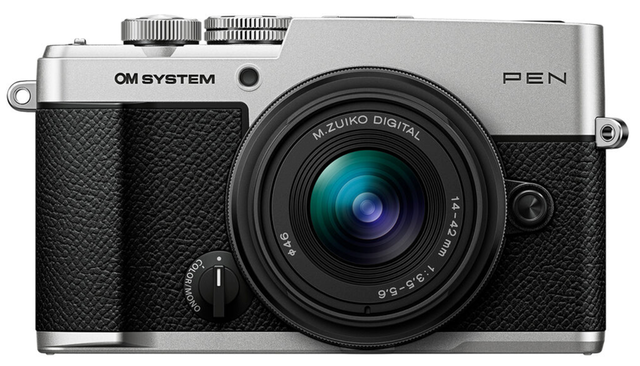
Many of the external attributes of the new camera appear to be a modernization of the E-P7 using the OM-5 II innards, though there are four significant changes: (1) the new body is weather sealed (IPX1 rating); (2) there’s now a rangefinder-style integrated 2.36m dot viewfinder; (3) the Rear LCD is now articulating instead of tilting; and (4) a new BLS-7 battery that produces 410 images (CIPA). At US$1000, the OM System PEN also bumps up in price from the E-P7 it appears to be replacing.
Inside we have a 20mp image sensor and TruePic IX (again, the OM-5 II versions). Stylistically, the new design does evoke some legacy look to it, particularly in the panda version of the camera. There’s a cleaner look to this camera than many previous OMs, and the slight bump grip on the right side is part of that. Personally, I don’t like the position of the ON/ViewMode switch, as that knob is in a place where it’s going to get accidentally triggered. I really don’t understand why the Japanese continue to make this type of design error, though it does keep the the controls all to the right and leaves the rest of the top plate clean.
The price places the OM System PEN well above the OM-D E-M10 Mark IV that’s still being sold, and well below the OM-3. My guess is that the E-M10 Mark IV has seen its last Mark. It never got the OM branding, and now it’s in a zone that would make it very difficult for a low-volume producer such as OMDS to make profits from.
It is interesting that this new camera also seems to indicate a shift in branding for the company. It’s not Olympus. It’s not OMDS the company, but cameras and lenses are now labeled as "OM System”. Some of this has to do with what trademarks OMDS inherited on the split from Olympus, but I’m surprised it took them this long to actually recognize the value in the OM portion and promote it to “system” status.
A couple of further thoughts…
First, I’m sure the PEN will sell quite well, particularly in Asia where the E-P models have done well. We’ll likely see a bump in OMDS unit volume again. But it essentially undercuts the OM-5 II, so I’d guess that we’re mostly going to see a shift of volume from one model to another, not a huge spike. The camera OMDS really needed is what I’ve been saying they should make for a decade now: a compact m4/3; Pen-styled, small, loaded with that computational tech provided by TruePic. That would have done more for their bottom line than the PEN we got.
I mention the OM-5II for a reason: it’s not much different in size (mostly the small viewfinder hump and bigger front grip), and uses the same technology. However, the OM-5II does sport some key differences: IPX53 rating, one-stop better IS, UHS-II support, 1/8000 mechanical shutter, and a slightly faster maximum frame rate. What it doesn’t have that the PEN has is the new battery, a new subject detection function, and a second Custom setting on the Mode dial. I’d rather have the OM-5II than the PEN, I think.
Second, the current omsystem.com Web site page for the PEN has a lot of images on it that feel crunchy or uncompelling to me. The redhead, for instance, has blown skin on one side of her face and overly pink skin on the other. Focus is on her teeth, not her eyes. It’s just not a portrait I’d be highlighting. But other images on that page seem dull or incorrect, as well, and skin tones are all over the place. Perhaps OMDS thinks they’ll illustrating Profile Control, but if that’s what the results are, why would I want it?
——————————
News
A Week Full of Lenses
Besides Nikon’s Development Announcement of nine Z CINEMA lenses, one of which (50mm t/1.9) was on display at IBC (International Broadcasting Convention) this week, we also got a number of literal lens launches:
- OMDS introduced another new (third) version of the 14-42mm f/3.5-5.6 R kit lens with the PEN, now moving to the OM Syystem branding from the original Olympus one. In addition, the lens is now IPX1 rated, and can focus down to 5” (13cm), which gives it a maximum magnification just under 1:4.
- Sigma announced the much-leaked 85mm f/1.2 Art lens, as well as surprise 20-60mm f/2.8-4 Contemporary lens. Both lenses show up for the Sony E as well as the L-mount. The 85mm sells for a reasonable US$1600, and has all the features you’d expect from an upscale portrait lens. Up front you’ll need 82mm filters, though. The 20-60mm f/2.8-4 clocks in at US$850, and the MTF values show why it’s at that price and labeled Contemporary, as it fits more of a consumer than prosumer spec. It’s a reasonably compact lens
- Sony announced the FE-mount’s first fisheye zoom, the 8-14mm f/3.5G (US$1600). Very similar to the Nikon F-mount 8-15mm, this lens produces full frame circular fisheye effects at 8mm, and full frame 180° diagonal coverage at 14mm. Filters are done via a rear gel filter holder, as the front optic is a bit bulgy for filters. The most intriguing part of the press release was the photo that shows two Sony full frame box cameras mounted side-by-side, each with an 8-14mm out front. The implication here is for some sort of 3D virtual reality capture, though I don’t know how you’d get them exactly paired in terms of focus/focal length except perhaps at extreme ends of the focal range (and using the Zoom Lock buttons) and hoping the focus is close enough.
- TLS joined the “re-house NIKKOR AI/AI-S lens” crowd with nine lenses that use the original NIKKOR glass, but puts them in new precise and video-friendly casing (0.8 MOD rings, big bright lettering, along with an Arri or PL mount). So we get 15mm t/3.9, 20mm t/3, 24mm t/2.2, 28mm t/2.2, 35mm t/1.5, 50mm 5/1.3, 55mm 5/1.3, 58mm t/1.2, 85mm t/1.5, 105mm t/1.9, and 135mm t/2.1 options. You can have your own lens re-housed for £3950 or just buy a fully done set for US$50,000 should you not have a set of old NIKKORS laying around.
——————————
News
Pentax Stops Making DSLRs to Make DSLRs?
In a 100% confusing official announcement, Pentax (Ricoh) announced that the current K-mount camera lineup is ending. To be replaced by a “new SLR concept” that will support the K-mount that will “take time” to develop. A lot of non-specifics in that statement.
The announcement has all kinds of head scratchers in it, some I’m sure intentional, some not. For instance, rather than using the term DSLR, they use the term digital SLR. I suspect that’s because what comes next is mirrorless, and the term they use is sloppy enough to include both DSLR and mirrorless. Then comes the confusion caused by “RICOH IMAGING will continue…” versus “next stage of PENTAX…” I sense a rebranding coming, perhaps similar to the OM System Pen, e.g. Ricoh Pentax or maybe even just Ricoh K.
The K-mount itself is confusing in the announcement. That the future cameras not yet designed “...will leverage the K-mount legacy...” is different than saying “we’ll continue to use the K-mount.” As for “allow more people to enjoy the process of photography itself,” in several places the press release alludes to “an entirely new concept,” whatever that might be. FWIW, most other sites are claiming that the press release says that Ricoh is developing new Pentax DSLRs. That’s not the way I read it. Indeed the headline is “PENTAX Digital SLR Cameras Aim for a New Stage.” The word usage is specifically vague enough that what appears next may not be what we’d call a DSLR.
As for the discontinuation of current Pentax DSLRs—or should I say DSLR, as only the K1- Mark II still seems to be available—no specific time was given for that, either: “we will discontinue…” doesn’t indicate that they have already done so, as some sites are reporting.
In essence, Ricoh/Pentax has basically said they’re going on a sabbatical to do some thinking and tinkering and try to reimagine themselves. Don’t bother to contact them, they’ll send you a postcard or two while they’re away.
——————————
News
Apple Introduced Their New Cameras Phones
Seems everyone was ready to get back to work after the Labor Day holiday. Apple introduced the iPhone 18 Pro (and Pro Max) with one of the big features being an f/1.48 lens on the main camera (24/48mm) with a user-controllable aperture diaphragm (down to f/4), new “pro controls,” additional photo styles, true subject focus tracking, 4K timelapse, front-and-back simlutaneous capture, and, not really played up in their announcement stream: reference image, Apple’s authenticity capability (only on the main camera).
Actual focal lengths (not the computed ones) are 13mm, 24mm, 48mm, 100mm, and 200mm in full frame equivalent values, though only the 24/48mm lens is fast aperture, using a larger image sensor (2.44 micron quad-pixel versus 1.4 micron quad-pixel). Apple outlines this as .5x, 1x, 2x, 4x, and 8x zoom, keying off 24mm (effective) being the focal length that’s based upon. Note that only the main (24/48mm) camera has changed from the iPhone 17 in terms of sensor and lens, the rest remains the same as on the iPhone 17 Max. Surprisingly, both the 18 Pro and 18 Pro Max versions have the identical new camera module, which was not what was rumored. The primary differences between those two phone models comes only in screen size (6.3 or 6.9”) and battery capacity.
The new iPhone Duo, which is Apple’s new foldable smartphone, runs just main and ultra wide camera modules to provide 13-48mm (effective), or 2x in Apple’s rounding. One thing the Duo has that the 18 Pro models don’t is “Smart Take,” where the phone determines when to take snaps while you’re away from the camera posing. Think of it as Smarter Self-Time mode, where the image isn’t taken at a specific time interval, but rather when the phone’s analysis says that the scene in front of it has stabilized. The other camera difference in the Duo is that it features an under-display camera for FaceTime calls when using the larger, folded out display.
It’s of course difficult to assess exactly how much, if any, image quality may have improved with this generation of iPhone without actually getting one and putting it to a real test, which I intend to do.
——————————
Explainer
What is LOFIC?
You may have seen that acronym appear recently in some articles about smartphones. Honor, Huawei, and Xiaomi have all introduced products with that technology in the image sensor, and Apple is rumored to be next (iPhone to be introduced in 2028). Current smartphones appear to be using Sony’s LYT-838 (50mp) or LYT-910 (200mp) sensors, but Apple’s own design may end up being produced by Samsung. Moreover, Apple’s design is a stacked image sensor that is said to incorporate image processing and noise reduction in the added layer.

The acronym stands for Lateral Overflow Integration Capacitor and is the long-awaited fill-the-photosite-and-then-fill-it-again technology some have been wanting for years. In essence, each photosite has two storage capacitors, a small one that keeps filling, and a larger one that collects what the smaller one keeps obtaining. Ironically, the overall full well capacity of a photosite goes up by using this approach, even though the initial storage well may be smaller (to make sure that it is fully used and gain can be kept low). The values of both capacitors need to be read, so you also need some sort of gain blending going on downstream.
Note that the real benefit being gained is typically more highlight detail. When you see reports of expanded dynamic range attributed to LOFIC, the noise floor is not really changing in the current chips. What is changing in the current implementations is the saturation point of the image sensor is being raised.
Currently, the only available LOFIC image sensors are all four adjacent pixels of the same color, though these are arrayed in a Bayer-type pattern. Moreover, these sensors cost more to produce and use more power than the simpler single-capacitor design. But the real potential here lies in getting HDR-like results without resorting to additional images, and the ability to handle high contrast scenes without blowing out the pixel data.
So this applies to large-sensor cameras, too, right? I’m not convinced of that, certainly not in the short term. Our large sensor cameras have very large full well capacities compared to the chips being used in smartphones. If you’ve tried HEIF in your camera and clicked on Adobe’s HDR button while viewing on a Retina display (HDR-capable), you may have been surprised to find that you already have a huge amount of highlight information that isn’t being used effectively in 8-bit JPEG images (between one and two stops, typically). Fundamentally, though, we still have the problem of fitting large capture dynamic range into displays/prints that are lowest common denominator. We still face the issue of where do we put any extra dynamic range and how do we display it, and the algorithms for doing that can produce results anywhere from crude (obvious) to decent (not obvious).
The real issue behind extended dynamic range is this: are you displaying your photos in ways that will use it? All of Apple’s current devices and displays can show more dynamic range than a JPEG can really show. Your 4K television probably can, too, as almost all recent ones are HDR-capable.
——————————
Commentary
Right Thumb On/Off
I’m suddenly seeing cameras that are turned on by something on the back right-top deck of the camera. The OM System PEN (above) is one of those, but more have and will appear. I get the design impulse: the user brings the camera up to their face and it’s off, the right thumb is in a position to quickly trigger it on. But it’s also in a position to quickly trigger it off accidentally.
Sure, at least one of those that I’ve used has a very stiff switch that’s not easy to move, but that switch will get used a lot, and generally the level of switches Tokyo has been using get less stiff with use.
There’s no perfect place to put on/off. On the Nikon’s its done with a ring around the shutter release, and I have on rare occasions managed to trigger that off when I didn’t want to. On many smaller cameras it’s instead a small power button near the shutter release, and often not recessed enough or distinguishable enough from other buttons; at least on the Nikon ZR the button is way over on the side of the top plate where I’m not interacting with anything.
The fact that Tokyo keeps experimenting with new controls and locations for on/off indicates that they know that we users have sometimes accidentally triggered a camera off just when we wanted to take a picture, or stuffing the camera in the bag turns the camera on and uses battery while we’re not using it. It’s a really tough design issue, as I’m not sure we’ve yet seen the “perfect” approach. But this does speak to those that keep switching cameras and brands: you’re not likely to build an on/off skill that becomes second nature, which means some day you’ll miss a photo or exhaust a battery or have settings changed accidentally because the camera was on when it was being roughly handled.
Drop Into Fall
LEDE ON
Turns out that September 1 was an important day, as prices changed for many items starting deep in the supply chain all the way up to finished products. Not all these price changes have surfaced worldwide to consumers yet, but they will.
In talking to sources on the semiconductor side, it’s a combination of CapEx (capital expenditures needed for expansion) along with the AI squeeze (the AI needs are sucking up more and more fab time) that are creating the biggest problems for everyone now, even huge companies that dominate some fab use, such as Apple and Qualcomm. I’ll point out that in past chip bubbles—yes, there have been several—the results on the other side are ugly: excess capacity and parts price drops that are challenging to navigate. As the bubble ends, a manufacturer can end up committing to a price only to find that their competitors waited and are paying far lower prices. You don’t just need bean counters these days, you need bean predictors to navigate the semiconductor cycles well, too.
——————————
News
Mirrorless Market Shares
As I continue to dissect the numbers out of Japan for 2025, some things that haven’t yet gotten a lot of coverage: Canon lost market share. Sony lost market share. Nikon lost a tiny bit of market share. OMDS lost market share. Leaving Fujifilm and Panasonic as the only ones making clear market share gains in mirrorless unit volume during the year.

The numbers that were most striking were OMDS’s slip to only 120k mirrorless units in 2025. Fujifilm’s mirrorless sales units went up by more than 2x the total number of units OMDS sold (e.g. 260k unit increase for Fujifilm). That said, Fujifilm remains #4 in mirrorless behind #1 Canon, #2 Sony, and #3 Nikon. Those top three account for 81% of the market. Add in Fujifilm and those four account for 93% of the market (all percentages in this article have been rounded). In essence, they are the market (again mirrorless market). Remember, though, Nikkei/Toyo Keizai really only count Japanese cameras. Leica and Hasselblad don’t show up in their results, for example, but do have enough sales to move the market percentages for the Japanese downward a bit.
If you dig deeper and make a few intelligent assumptions, you also see something else. Overall, Nikon’s share in percent of dollars received is far higher than their unit share (approximately 20% for dollars by my calculations). It’s tough to get a precise accounting of dollar shares for each company here, as only Nikon breaks out enough numbers to do calculations against CIPA and other data. As myself and others have pointed out, Nikon is particularly strong in full frame (FX) body sales compared to the competition, and less reliant upon crop sensor (DX) in sales. The Z5II to Z9 lineup is strong and holding serve.
Fujifilm’s big increase in unit volume does come in the crop sensor (APS-C) market, and that’s exactly where Canon and Sony lost market share last year (based upon my evaluation of some private regional data).
One thing that did surprise me is that implied in all the CIPA/Nikkei/Toyo Keizai reported unit volume statistics for 2025, Fujifilm appears to have sold fewer digital compact cameras than I expected. I would have thought their compact number would have been far higher, particularly given that Fujifilm has a trio of X-players there. But the X100VI keeps going out of stock, so I’m guessing that Fujifilm is not meeting their monthly goals and having to ration 40mp image sensors across their line. The X-T5 probably has a higher gross profit margin, thus that camera may be getting the nod for more of the available chip pile.
Given that mirrorless unit volume is down so far in 2026, no doubt we’ll be seeing a different picture in the 2026 Nikkei/Toyo reports when they appear in mid-2027. Unit volume for mirrorless is down 6% while dollars taken in are up 3%, which is saying that “pursuing volume over price” is transitioning again to “pursuing price over volume.”
Meanwhile, it appears that the Fujifilm-loyalist sites (e.g. Fujirumors) are fighting other sites' (e.g. Petapixel) characterizations of all these numbers (plus making unsupported claims, such as that Nikon has more production capacity than Fujifilm, which I’m not sure is true anymore). It’s unclear to me why who's #3 or #4 are so important. Yes, Fujifilm is growing, and growing faster than the other Japanese makers. Fujirumors makes a point about the three year growth in mirrorless (Fujifilm 97%, Panasonic 93%, Nikon 36%, Sony 18%, and Canon 17%), but we already know so far in 2026 those growth numbers won’t be sustained, as the overall mirrorless unit volume is down 6% year-to-year. With unit volume down, market share growth now has to come at someone’s expense.
Frankly, I don’t care about winners and losers, and certainly not at the #3 and #4 position. I follow this information because it tells me something about priorities. Nikon executives several years ago said that they would emphasize prosumer/pro products, and they appear to have executed to that goal. They’re taking in more dollars a unit than the others are. I’m not sure what Fujifilm’s actual goals are, though. When you press Fujifilm executives they don’t seem to want to talk about that subject, they just want to point to already achieved successes.
What I look at with camera companies is history (how they’ve managed in the past), currency (how they’re managing the current environment, which as you know has tariff, inflation, supply chain and other components adding friction), and what their goals are going forward. Curiously, Nikon executives tend to be pretty good at providing information about the first and third, but not so much on the second (present).
All the current mirrorless products produce great photos. Yes, some have additional performance or features that extend them beyond basic photography use, but what’s been true for some time remains true: if you’re not getting really good images out of your current camera, it’s not the camera that’s at fault. As I predicted some years ago, once mirrorless fully took over from DSLRs, it was going to be tough to keep generating more unit volume with new models and model iterations. Well, we’re there now. The adoption hockey stick growth for mirrorless is now fully traversed, and we’re back to a volume plateau again. Companies are going to have to make splashy moves—i.e. features/performance the others can’t match and that also generate viral user response—to make big unit volume gains now.
——————————
News
Color Me Perplexed
GoPro is merging with Starman, which makes transceivers, and I’m not seeing the connection (pardon the pun). Starman is a nascent <50 employee company making optical interconnections that are designed for hyperscaled data centers. Essentially, those transceivers are designed to provide connectivity between GPUs and servers via optical networks. How that ties into—dang it, ThomAI stop with the puns—action cameras is unclear.
The press release says “creates a unique opportunity.”
Unique indeed. Nicholas Woodman, GoPro’s founder and CEO says this will allow GoPro to “grow across consumer, commercial, and defense markets,” while Starman's CEO cites “GoPro’s world-class optical expertise [sic?].”
Here’s my take: Starman Photonics, part of the Starman holding company behind the merger, is a new, private AI Data Center player. By merging with GoPro they end up on the NASDAQ stock exchange as a publicly held entity and can then try to take advantage of the AI investment surge going on. From GoPro’s standpoint, their debt is completely removed in the acquisition and each shareholder gets about a dollar in cash, though their ownership is diluted 10:1. From Starman’s standpoint, they’re now a public AI company on the NASDAQ and can go around promoting how they’re an undiscovered investment opportunity in the hottest industry of the moment, and oh, by the way, we’re building a US factory. Indeed, the subhead on the press release included “positioning GoPro to expand into AI Data Center, Government, Defense, and Aerospace Markets.”
Charles Tebele, the CEO of Starman Holdings is someone I once met (at COMDEX), and comes out of the personal computer retailing industry, so it’s not difficult to imagine Woodman and Tebele crossing paths at some point, too. Given that Tebele seems to assemble disparate companies under his holding company, maybe this is just another of those transactions. Still, I fail to see the synergy that makes the sum of the parts greater than the sum of the parts.
My doubts aren’t unique. So much negative energy among the GoPro-using crowd was generated by the merger announcement, Woodman felt he had to write a “we’ll keep doing what we’ve been doing” letter to tell the user base that not only will the GoPro lineup continue on, but will be expanded with new offerings now that they’re no longer financially challenged.
I say not-so-fast to Woodman’s accounting here. Looking at GoPro's last financial quarter, the operating loss was US$38.8m on US$104.9m in sales, which represents more than their cash on hand position at the end of the quarter (the merger generates no new cash). The good news is that the new cameras didn’t really show up in that previous quarter, so the operating loss might go away as deliveries really happen. The other good news is that they restart debt-free, so GoPro should be able to borrow if they need more cash.
The problem is that DJI and Insta360 have essentially taken over the action camera market and extended it. GoPro is going to need to move fast and dramatically with product and messaging to get any real traction again. I believe that was the point of Woodman’s letter to customers: he’s trying to stem the tide of folk who are leaking to other brands by reassuring them that they should stick around. The problem is, without details such admonitions don’t tend to do much. “We’ll be great again” is far different than “Here’s how we’re going to be great again.”
That said, the merger has bought Woodman and his GoPro cohort time to show that they can indeed turn their fortunes around. However, given the long decline, the road back up will be tough to navigate.
——————————
News
Keep on DxO-ing
We’re coming into the traditional period where the big software packages get upgraded, and this week we have the release of DxO PhotoLab 10 (hmm, I was just starting to use 9 for a few things). The additions this time are Depth Masks (e.g. foreground, midground, background), a new color control option, Adobe-like People mask breakdowns (eyes, hair, lips, teeth, etc., though this only works for the face), a bunch of UI and performance refinements, and interestingly, the ability to send the image to Affinity for pixel-level changes.
If you’re coming from PhotoLab 8 or 9, the upgrade price is US$130, which effectively means that by “keeping up” PhotoLab 8 users are paying ~US$5/month and 9 users are paying ~US$10/month (see what I did there?). As I’ve long said, the real problem with Adobe’s subscriptions is that if you let them lapse you end up with a shell of the former product, but if you kept them up you weren’t really paying more. At least with the older yearly update model products you can get off the pay wagon and keep using what you’ve got. (I should note that I’m now leaning towards recommending that you don’t do that (get off the paid-for update or subscription wagon), as security issues are rapidly compounding now for those that don’t want to keep up with current builds. That starts at the OS, for sure, but I’ve now started seeing attempts to break into older applications to get access you just don’t want to give malicious characters.)
——————————
News
We’ve Got the Lens, Now About That Body...
Fujifilm this week announced their 400mm f/4.5 R LM OIS WR lens (and once again almost exhausted the alphabet). What’s interesting is how closely Fujifilm mimicked Nikon’s specs with this new lens, as it’s close to rounding errors on most things like size and weight. Also curious is the use of two extremely similar Super ED elements in a key group orienting the light rays for the focus/stabilization point in the lens. This new lens is Fujifilm’s second real “exotic,” and at US$3200 it undercuts Nikon’s excellent 400mm f/4.5 by about US$300.
The problem I have at the moment is that, even with the X-H2s, I’m not sure Fujifilm’s autofocus system is fully up to what I expect when using an exotic (it isn’t with Fujifilm’s earlier exotic, the 500mm f/5.6). Moreover, Sony is about to launch their 400mm f/4.5GM, and undercut both Fujifilm and Nikon in weight, and both the current Nikon and Sony cameras have arguably faster and more reliable autofocus for the situations where you’d use an exotic telephoto. My hope is that Fujifilm has been hard at work on their autofocus system, because right now I find it good but not great, and not at the level of the top three players (Panasonic is even further behind, IMO).
Still, the 400mm f/4.5 is a great new addition for the sports/wildlife crowd using Fujifilm APS-C bodies. A handholdable 600mm equivalent with good light capture attributes extends the usability of their top cameras.
It is interesting that we’re seeing so much activity in the telephoto game at the moment, where the Chinese lens makers aren’t yet really playing.
——————————
News
It Only Took 20 Years
Long-time readers of this site may remember that I started prostelitizing communicating, programmable, modular cameras early in the century. We got one half-hearted attempt at modular in the Ricoh GXR, one half-hearted attempt at programmable with Sony’s PlayMemories system, and everyone’s half-hearted attempts at communications with sometimes-connects-with-camera apps.
German CircuitValley is now doing two of my three (modular and programmable) in a Kickstarter project targeted at researchers, scientists, and tinkerers of all sorts. The CHC5 has modular lens mounts (RF, E, and m4/3 are among those offered) and modular image sensors (various Sony IMX models ranging from 5 to 20.3mp, though the largest image sensor currently available is an m4/3-sized one). A basic interface board supports USB3, HDMI, and Ethernet, but you can also get an interface breakout board if you’re included to roll your own. Software is Open Source, allowing for customization.
The CHC5 isn’t really a mass market product, though, so I’m not going to send you running to the Kickstarter site. I used the word tinkerer earlier, and that’s really where this new camera exists at the moment. However, it illustrates a point that I made 20 years ago: there’s nothing that says that cameras have to be fixed in nature and replaced completely at every upgrade point. It’s a different business proposition than selling one-off boxes for a couple of years and then selling a different one-off box as an upgrade. And it appears that none of the camera companies really want to tackle a different business, even though it would be more environmentally friendly.
As I pointed out when I reviewed the Ricoh GXR and some of its modules when they appeared, the body basics—shape, size, controls, etc.—were relatively locked in by the 1980’s (some might argue for an even earlier date). Interchangeable lenses were an obvious “module” and we’ve had them for well over 50 years now. Things inside the camera kept changing as we moved from analog parts to digital ones, at first gradually, and then dramatically. However, once we got to all-digital innards, it became clear to me that we could modularize that, add programmability and communications and have a whole new beast. Moreover, that would have probably locked you more into a brand than the way the camera makers ended up proceeding.
At a meeting with Nikon executives in 2011, they rejected my ideas for programmability and further modularity, though they ended up running with the communicating thing, which eventually became SnapBridge. While I doubt that moduarity will ever be attempted again in Tokyo and that means that the one-off box parade will continue, I think it’s time to raise the programmability rallying cry again. I’ve been vibe-coding with my local Large Language Module for awhile now, and I can now clearly imagine how you could bring real programmability into the cameras that would allow consumers to make useful functions of their own instead of having to rely upon what Japan thinks they might want.
——————————
Commentary
The World Keeps on Turning
I earlier mentioned that you now pretty much need to stay current with what you’re using (OS, app) from a security standpoint, but Apple this past week also re-iterated that it’s a fully Apple Silicon world moving forward. They notified developers—yes, I’m a registered Apple developer, and an active one—that they can begin dropping universal application support.
A universal application supports both Intel processors as well as Apple Silicon (which is ARM-based). While you can still run Intel code on the impending macOS 27 (Golden Gate) via the Rosetta 2 function, the macOS 28 that will be announced next June will not include that.
Given that photographers are more likely to own a Mac than the general public, I’ve already been counseling a number of them about the fact that they really need to have a plan to move on from their Intel-based Macs. If your Mac is online, it needs to be secured, and the only way to do this is to stay current with the macOS and perhaps add another layer of security, such as Intego’s Essential (antivirus and firewall). You also need a current and updated router, as well, not the router you’ve been using for ten years or more.
As an app developer (surprise!) I have to make decisions about how far back I want anything I produce to support. This isn’t as simple as it might seem. Supporting anything other than the current macOS (Tahoe) and Apple Silicon opens up so many cans of worms that it hurts my brain contemplating it. Since I program in Swift this problem is doubled, as Swift is relative forward looking as a language, not legacy oriented. But the real developer issue is that you probably end up having to virtualize every macOS version you support, plus you need to have virtually every differing Mac architecture available to test on (for current models, that would be Neo, MacBook Air, MacBook Pro, iMac, Mini, and Studio, but that expands if you include Intel-based Macs). For smaller developers, or ones who want to stay nimble, I can see them dropping everything but current macOS support, and sticking to Apple Silicon only. It’s what Apple’s developer tools are optimized for now.
So some advice for photographers:
- If you’re going to stay on Intel Macs — (1) move to macOS Tahoe (if you can); (2) lock in the apps you’re using, as they might not update again; (3) start bolting on extra security for the day you can’t update the macOS again, which is not much more than two years out; (4) seriously consider moving to an Apple Silicon Mac (you’re missing performance, security, and even features from what you’ll be getting from your Intel Mac).
- If you’re on an Apple Silicon Mac — (1) stay current with the macOS updates; (2) make sure the apps you’re using are fully Apple Siliconized; and (3) for those apps that aren’t that you will still require in the future but which have Intel code in them, consider creating a virtualization of the current macOS you can continue to use in the future.
When my new site is ready, I’ll have much more to say about Macs and Mac software. This has been an “investment” year for me, where I’m spending a lot of time making sure I’m ready for the next half decade or so, and so I’ve been dealing with hardware, software, AI, Internet, and a host of other technologies that are in constant movement and flux. I’ve had to update my thinking on virtually everything Mac (and Internet, for that matter), and make sure that I’ve got the right tools for the coming times. At times this has been daunting, as I’m a one-man band playing in an arena with a lot of loud Heavy Metal groups also making noise all around me, but I have to say, it’s been fun. I’m starting to feel a lot like when I was previously most productive, which was the Connectix years in the 90’s. Having a Large Language Model sitting on my desk (literally) is also fun, as I’m using it to accelerate my learning in areas I was falling behind on.
But the point I want to make is this: the constant updating and upgrading on the computer and application side can be annoying, but it’s the cost of staying relevant and productive now. I remember early in my career when all this “digital stuff” started creeping into my analog worlds. That was also annoying as it kept changing rapidly, but keeping up was also one of the things that propelled me to where I am today.
——————————
Commentary
“You Can’t Take a Photograph With a Rumor"
That thought appeared on dpreview recently (@jtr27). It’s something I’ve been preaching for many years now, and links up with the notion that “the best camera is the one you actually have in your hand” thought.
I mention this because some of the rumors that have been making the rounds about some future cameras lately are, well, wrong. Or rather I should write “will turn out to be wrong.” Because I write a lot of things far in advance (sometimes under NDA) and then perform any last minute corrections and editing just prior to posting, I can tell you several upcoming comments I will post when a product releases will have to talk about, at least briefly, those “wrong” rumors.
Rumors are a natural phenomenon, and they do have a mildly useful function in that they tend to surface user-frustrations and expectations in response. We’re getting lots of rumors flourishing in the fora right now because of two things: (1) the lack of any new products to talk about; and (2) the fact that most of the companies have severely tightened how much information gets out prior to launch. The second isn’t just due to the usual attempts to secure the marketing messages, it’s also because those same marketing messages aren’t even known internally until almost the last minute now. I saw that first-hand with the Nikon Z9, where the original internal notion of what would make it into the shipping camera didn’t fully materialize (at least not until three large firmware updates later provided them).
As I’ve noted before, we have a handful of new camera announcements coming this month. Thus, we’ll soon be able to stop talking about some rumors and start discussing the actual product. I look forward to that ;~).
——————————
Commentary
Samsung and Ricoh Need Some I
I noticed in Samsung’s P9 SSD launch that a lot of the materials were marked as being AI generated, though I didn’t report it, as SSDs are a little off-topic for me. It seems I wasn’t the only one to see slop, though. There are now multiple threads and articles from the folk the product was directed at—professional videographers—that Samsung was basically using the type of work to promote their new product that would put those buying the product out of work. Talk about disrepcting your user. Oops.
Cined was pretty direct: “So the drive that is supposed to hold your footage is being sold with footage nobody shot.”
Even the still images in Samsung’s launch campaign were pretty AI-revealing: “talephoto” and “vulture cirsting” were two of the text blocks some image generation AI thought might be relavent to the audience for one photo. That is the equivalent of just slapping the customer in the face with slop that even Hollywood tries to avoid when they do use AI.
Meanwhile, Ricoh appeared to be up to something similar, using AI-generated images to promote a camera that doesn’t take AI-generated images. When confronted, the image was taken down, which sure looks like an admission of guilt to me.
I get it. AI has many useful benefits, and can help someone that knows how to use it correctly to up their game on things like marketing campaigns. But when you simply disrespect your desired customer by slopping nonsense in their face, you should expect that to backfire.
Ironically, the camera companies have been showing this kind of disrespect for decades now, long before AI got useful. Pretty much every year we seemed to get some company using “example photos” for their new camera that weren’t taken by said new camera, but were instead just licensed from somewhere else (and taken with different cameras). Hire a dang photographer and have them actually generate your examples! It’s not difficult. You own the rights. You can show off real capability. You don’t disrespect your intended customer.
Put another way, the camera (and tech) industry needs to be less artificial, and more intelligent.
——————————
Prediction
A Relatively Quiet IBC
IBC (International Broadcasting Convention) starts on September 11th, and as far as I can tell, it’s not going to be a hotbed of new camera introductions as it has been in some previous years. Judging by the early press releases (some under NDA), I’m not seeing a lot of pending news that’s going to make it to this site. More Chinese and Japanese lenses, for sure, but other things in the DSLR/mirrorless space I typically cover seem few and far between. I’m not sure I’d characterize OMDS’s upcoming Pen announcement as IBC-related, though it does come just prior to the show (on the 9th; I’m not disclosing anything secret here, as OMDS has been teasing this release for a week now).
This is not to say there won’t be any newish cameras at the show. GoPro, Sony, and others have had recent launches that will get some of their first public displays and marketing at IBC.
Nikon-owned RED issued a (public) press release this week summarizing what to expect from them at IBC, and that featured areas we haven’t seen Nikon directly involved with in awhile: live broadcasting and immersive 3D experiences (with V-RAPTORs). But in terms of something new, I’m not expecting anything to be announced at the show itself, though it wouldn’t be out of the question to find a new cinema NIKKOR or two behind glass.
Get Ready for Change
LEDE ON
This week I write about new products, existing (Adobe), announced-but-not-imminent (Ricoh), and upcoming (additional new cameras coming in September). So it seems only appropriate to also say something about Apple, as they have called the press to the big circle for a launch-a-thon soon (on the 9th). The big anticipated camera news from the fruit company is that they’ll finally introduce variable apertures on an iPhone. Probably not more than two settable apertures, but a lot of us are scratching our heads about this, as the math of small-sensor-size has us already deep in the diffraction zone, so it’s unclear to me that there’s all that much real visible impact.
Unless, of course, Apple is doing something on the computational side. For instance, many smart phones already use a stream of images taken around the the chosen one to help reduce noise. What if they did the same with aperture? That would help them build a better depth map and computationally adjust subject and background accordingly.
Most of the initial speculation on why Apple is adding an aperture to the iPhone camera basically says “will help limit overexposure.” I wasn’t aware that my current iPhone was having any significant problems with that, but…maybe.
——————————
News
Who Needs Interchangeable Lenses?
With the success of the Ricoh GRIV, Ricoh has decided to once again clone the same camera, but this time with a 40mm equivalent f/2.8 lens (the original is 28mm equivalent), to be called the GRIVx. Instead of interchangeable lenses, it seems Ricoh is suggesting that you buy shirts with multiple pockets. But don’t worry, you have time to order those new shirts, as Ricoh only made a development announcement, and the target date for actual release is “Winter 2026 or later.”
This isn’t a new tactic for Ricoh. They’ve done the same thing before, for example with the GRIII and GRIIIx models. And speaking of which, at the bottom of the press release Ricoh indicates that all the GRIII models will go out of production in October, due to some parts no longer being available.
As for details on the GRIVx, Ricoh basically published the same spec sheet as the GRIV, with the primary difference being the lens (eight elements in six groups, three of which are aspherical). The lens does have a macro mode, focusing down to 4.7” (0.12m) instead of the usual 7.9” (0.2m). You also still get the direct in-camera crop capability, this time at 50mm and 71mm.
Now let’s see, is my 28mm GR in my left or right shirt pocket?
——————————
News
Adobe Cloud Rains Features
This is starting to almost become a “be careful of what you wish for” horror show. So before getting to several interesting new features in the latest Creative Cloud releases, let me back up a bit and describe the popular sentiment when Adobe switched to subscriptions: the basic idea was that the monthly tithe was too much and Adobe wouldn’t really keep innovating regularly once they had you under contract. I argued that this wouldn’t likely be the case, and it turns out I was correct: we’ve seen an unending stream of Adobe adding interesting, useful, and sometimes first-mover features to their products.
Photoshop seemingly gets better about every time I need to do a deep session with it. But that’s becoming a bit of a problem, too. Many of the things Adobe is adding now end up changing workflows. Or at least require you to think about changing your workflow. And the constant flow of tech changes, not just within Adobe’s software but with OS’s, other apps, AI, security, et.al., is starting to get tiresome, even for those of us who’ve been riding the tech wave for decades.
Which brings me to the new features. In particular, the two that are most interesting this time are the addition of Glow to ACR, and the addition of a Light adjustment layer to Photoshop. Both are welcome and useful, but they really are forcing me to not only rethink my Photoshop workflow, but prodding me to go back and start re-editing photos.
Glow comes in three types, one of which is an Orton-like effect, another of which is a diffusion block removal (to help better mimic a film era look). I tend to apply Orton techniques, but have been doing that after demosaic and other adjustments. Now Adobe gives me the ability to do it along with demosaic. The look from ACR is a bit different than the one I get from traditional techniques, so now I have to evaluate which look I like better, and if it’s ACR’s, then my workflow changes. As an aside, Adobe made some odd decisions with Glow (highlight changes when sliding left, not right, for instance, and shadows vice versa), and as usual, there’s a lot of potential nuance you have to navigate. However, this new feature is very nicely done overall, and the fact that Glow works both globally or with a mask is also interesting. Indeed, that last aspect alone will probably cause me to use it in my (new) workflow.
Meanwhile, the Light adjustment layer is effectively the Exposure, Contrast, Highlights, Shadows, Whites, and Blacks sliders isolated out into a new adjustment layer. How this impacts my workflow is that I sometimes find that I want to make an adjustment to those for something, so I duplicate a layer, then apply Filter > Camera Raw Filter to get to those sliders, make my adjustments, then go back and mask it in the layer. This new adjustment layer allows me to do the same thing more quickly, and non-destructively. (Some might ask why I don’t use a Curve layer. In my experience, getting fine nuance via curves is trickier and more time-consuming. And on my laptop screens, the actual curve component can be quite small, making it even more difficult to get exactly the effect I want.)
I should note that I stopped saving most of my photo edits in Photoshop PSD format a while ago. What’s been happening is that with all the changes that we keep seeing in ACR and Photoshop, I’m better off rebuilding any image from the raw file than trying to mess with layers and adjustments I’ve previously made. As I wrote earlier, be careful what you ask for, as Adobe seems to be providing you a constant stream of it.
——————————
Old News
OM Digital Solutions Now Management Owned
I hadn’t fully caught this when it happened, as I was out in the bush and then returned to have to deal with a family emergency, but OMDS changed hands this year. Originally, Olympus spun their camera group off to Japan Industrial Partners (JIP), the same group that salvaged (or is it savaged?) the Vaio when Sony spun their laptop group out. In April, the OMDS management team—most of whom were originally at Olympus—acquired 100% of the company and JIP is no longer involved. Thank goodness, since JIP is like most equity investment firms: they play the spread between interest rates and free cash flow to make money. Decisions they’d make about products are dictated from protecting that spread.
The good news is that this latest iteration of OMDS claims they’re back in the innovation game, and they’re teasing a new m4/3 Pen-type model to debut on September 9th. The bad news is that at 150k total camera units last year (that includes 30,000 Tough7), OMDS is re-starting from a weak position. Last years sales were about US$225m, and that produced a US$10m loss. We all hope that the New Pen helps them grow. Check back in a couple of weeks for my thoughts on the new camera.
——————————
Commentary
September Showers Now More a Drizzle
At the moment I expect at least three new significant cameras to be launched in September after Labor Day (the New Pen I just mentioned is one of them). Several months ago I was anticipating six September splashdowns. One was the Ricoh GRIVx (see above), though this has turned out for the time being to be just a premature development announcement. I’ve just been made aware that two more that were going to be launched in September have been pushed back. Despite that, it seems that the camera makers are coming out of hibernation now. We should see a modest stream of new products starting in September and lasting through November. We may even see some items appear during the holiday buying season, though that’s a lower possibility. Dealers have already spent their cash loading up inventory by early November.
What I’m wondering about is not so much new products, as they’re inevitable, no matter why they might have been delayed. The real issue I’m interested in at this point is cost. Sony recently took the introduction of their FX5 as an opportunity to adjust all their cinema camera pricing upwards. I’m pretty sure that we’re going to see another round of price bumping soon, which is in conflict with what people expect at the end of the year.
News/Views
- October 2026
- September 2026
- August 2026
- July 2026
- June 2026
- May 2026
- April 2026
- March 2026
- February 2026
- January 2026
- December 2025
- November 2025
- September 2025
- August 2025
- July 2025
- June 2025
- May 2025
- April 2025
- March 2025
- February 2025
- January 2025
- December 2024
- November 2024
- October 2024
- September 2024
- August 2024
- July 2024
- June 2024
- May 2024
- April 2024
- March 2024
- February 2024
- January 2024
- December 2023
- December 2022
- December 2021
Looking for older News and Opinion stories? Click here.