What is it?
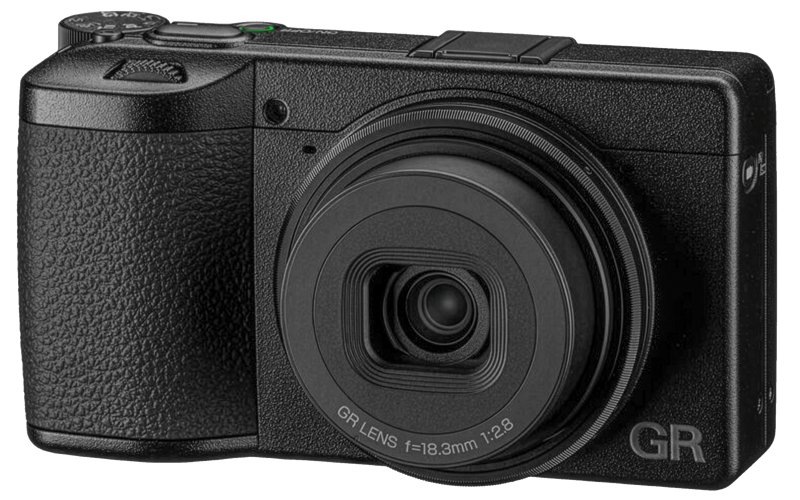
Ricoh has been very consistent in their GR designs: a shirt-pocketable APS-C (crop sensor) camera that uses the old compact camera Direction pad overload as part of its primary set of controls.
Yes, this camera is shirt-pocketable, as its quite thin at 1.3" (33mm) thick, and only 2.4 x 4.3 (61x109mm) in the other dimensions. 9.2 ounces (262g) also doesn't tend to weigh down your pocket as much as some of the other touted pocketable cameras.
So let's start with that: this is a small camera, and that in itself has consequences. The hand grip is minimal (but there), and there's not much body area in which to stick controls. Likewise, to keep the camera from getting thicker, the Rear LCD has no tilt or swivel adjustment (which would add thickness), and to keep the camera from being too tall for a pocket, there's no viewfinder up top, either.
Basically, the GR IV's design looks like it was flown in from the late 1990's, when compact cameras were everywhere and no one had smartphones in their pocket (okay, a few did).
Hidden away behind an automatic "lens cap" shutter is a 18.3mm (28mm equivalent) f/2.8 lens that normally focuses down to 4" (10cm), but can be macro-goosed to 2.5" (6cm). The optical design is a simple 7 elements in 5 groups, but Ricoh is now using an aspherical element at the rear as well as four high-refractive index elements to help correct aberrations.
Ricoh's published MTF figures look very good overall, and suggest almost no coma or field curvature. Apertures run from f/2.8 to f/16, but there's a built-in ND filter capability that can help you with bright light. Ricoh sells (an expensive) 0.75x conversion lens that can fit out front and give you 21mm equivalent, but you'll lose the shirt pocketability if you have that mounted.
28mm means a 65° horizontal angle of view, which many will find wide, others will find not wide enough. Most of the compacts with fixed lenses tend to be either 28mm or 35mm with a very few at 50mm, so the GR is at the wider end of that continuum.
Behind the lens is a Sony Exmor 26mp back-illuminated APS-C sensor that produces 6192 x 4128 pixel images in JPEG or DNG form. Technically the GR IV will go to ISO 204800, but as with most APS-C, a solid 12800 is probably where you'll end up stopping (base ISO is 125). The image sensor sits on a 5-axis stabilization system that Ricoh claims six stops CIPA testing for (center axis; 4 on the periphery).
Surprisingly Ricoh limits the video capabilities on the GR IV, though this does keep things simpler for the still photographer. If you need video, you can record 8-bit H.264 at FullHD up to 60 fps. Yep, no 4K, no 10-bit, no H.265, no R-Log, no HDMI connection, no headphone or microphone jack. The GR IV is really a photo-first (and almost only) camera. Apparently the GR ENGINE 7 ASIC that runs the camera doesn't speak video fluently.
The GR IV has a new focus system, which uses on-sensor phase detection. Coupled with some lens changes, this new GR is clearly better than the older ones at focusing. Ricoh claims better low-light performance and subject detection, as well. But that subject detection is really just faces and eyes, it's not the more sophisticated systems you see in the advanced mirrorless cameras these days. Ricoh includes a crude focus limiter system (near, far, off), but this does provide some ability to keep the camera from too much focus hunting.
Up top is a lens-aligned flash hot shoe. Ricoh makes a really small GF-2 flash unit for the GR IV, but it's odd, no-featured, over-priced, and a pain to use. Skip it and pick up some other small flash unit and learn how to dial in manual flash levels (aperture = GN / distance is your friend).
Out back is a 3" 1.04m dot TFT touch screen. Normally, this uses auto detect for brightness, but it does have a bright (+2) setting that you're likely going to want to investigate if you use this camera outdoors.
The GR IV contains 53GB of internal memory. If you want to use cards, get ready to be frustrated, as the camera takes microSD cards and the slot is under the battery compartment door and really difficult to finesse. On a Mac, your best image transfer mechanism is going to be the USB-C port and Apple's Image Capture program.
For power the GR IV uses the Ricoh DB-120 battery, which wimps out at 250 images CIPA. USB-C charging is supported.
Ricoh makes a big claim about how fast the GR IV starts up (0.6 seconds), but frankly, that doesn't seem fast to me.
The GR IV retails for US$1500 and is made in China.
Ricoh's Web site for the camera
Source of reviewed camera: purchased
How is the GR IV Different than the GR III?
Most of the difference is internal: the image sensor went from front side illuminated 24mp to back side illuminated 26mp. Phase detect was added to the image sensor, more internal memory was added, and a newer, faster GR Engine processor was introduced. The image stabilization improved two stops (CIPA) and is now 5-axis (GR III was 3-axis). Battery performance also improved.
Physically, the GR IV is a little heavier (23g, mostly due to the newer, bigger battery), and it regained the ± toggle bar that the GR III dropped (the GR II had it). The GR IV also went to microSD from the SD support of the GR III.
The retail price here in the US went up US$600. However, the GR IV is faster, delivers better quality images, and has other benefits the predecessor didn't.
How's it Handle?
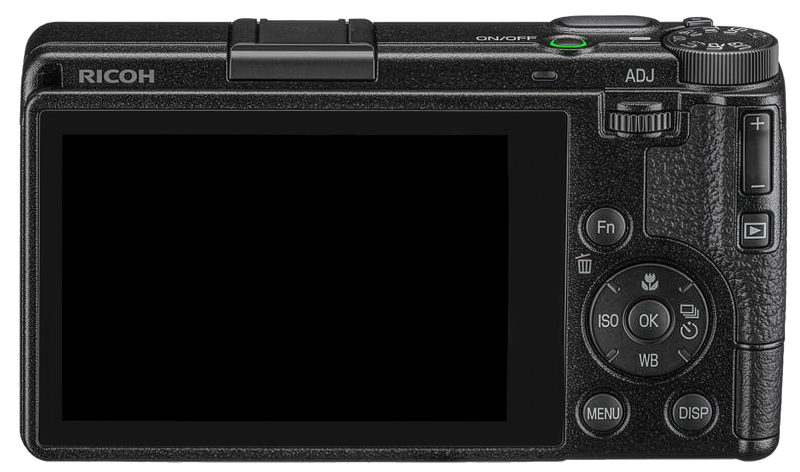
The GR IV inherits a lot of that, but it's now more dependent upon "control override" (controls that do multiple things depending upon context). For instance, the Rear Command dial can be pushed as well as dialed, and that's a customizable action. Curiously, not so the Front Command dial (though given it's 90° orientation flip I guess that's not surprising).
The big overload comes on the Direction pad, where you have Macro, Drive, WB, and ISO controls available at default settings. In addition to those controls, you have a single Fn button and a ± toggle that defaults to exposure compensation. Surprisingly, the top Mode dial is locking, and has U1, U2, and U3 positions that can be customized (plus there's a Sn position that is effectively a weird hyperfocal control).
So, for a truly compact camera, there's a fair amount that you can customize to get the camera to operate the way you want it to. That's the good news.
The bad news is that this is a small camera and finding and using all the controls can be touchy. At least Ricoh didn't make buttons indented like Fujfilm and Sony, but you're still not going to find them as easily as on a bigger camera, and probably not at all with even minimal gloves on.
The Direction pad overload means that you're going to hit the Macro "button" accidentally on while photographing sometimes and wonder why the camera isn't focusing correctly for distance. This is one of those "camera will force you to learn a habit" things: if the camera isn't focusing, maybe check to see if you're in macro mode.
The ± toggle, meanwhile, is also too findable. Since it's default programming is exposure control, I kept finding myself accidentally dialing in random exposure controls.
Moreover, all the controls feel more consumery than you'd expect on a US$1500 camera. People with big, thick fingers are going to have trouble with some of them, too, such as the Front Command dial nestled so close to the top front edge of the camera or that the very small ± toggle bar that is too easily pushed accidentally.
Some other good news is that Ricoh's kept their simple menu system. For the most part the GRIV menus are very easy to navigate, and Ricoh has mostly avoided the scrolling menu problem in a unique way that works quite well. That's negated slightly by some confusing names (what's a "Mode Box" and why would I need USB set to "License Display"?).
All in all, handling is a respectable tradeoff. You'll probably have an adjustment period that's frustrating as you try to get the GRIV configured in a way that you feel 100% in control all the time. Once set the way you like, I'd suggest just concentrate on taking photos and don't think you're going to menu dive or get fancy with controls.
Before I leave the subject, I should point out that my GRIV seems to have a tendency to handle itself. I've too often pulled the camera out of my pocket to find it warm and only displaying the RICOH signoff screen. The camera won't turn off at this point, so you have to remove the battery. And, of course, all that time the camera was warming up for you (literally), it was consuming some of that small battery. I don't know if this is a general defect of the design, or something wrong with my specific unit, but it's annoying (plus you'd better have an extra battery with you).
How's it Perform?
Battery: The CIPA number suggests that you can power the GRIV continuously for just over two hours. I'm finding that optimistic, and tend to say 90 minutes is what you can comfortably expect. My suspicion is that the fact that I'm writing to a microSD card—the camera was tested using internal memory only, I believe—and doing a lot of continuous autofocus is producing that result.
But even if you could get the full 125 minutes suggested by the CIPA number, that's still unlikely to last a full morning's photo session for someone taking a lot of images. The GRIV, like the Sony RX100 models, is a camera where I'd never be comfortable with only one fully charged battery. Carry one or better still, two extra fully charged batteries with you.
Buffer: The GRIV isn't a speed demon in continuous release mode. It's not even a demon. Ricoh says 4 fps, but that appears to be only with JPG to internal memory, and not at high ISO values. Moreover, one thing that surprised me is that the camera isn't always continuous. There appears to be no regularity to "continuous." Click pause Click pause Click Click pause Click Click Click pause Click. (This is with JPG+DNG, ISO 3200, and a UHS I microSD card.)
Should you actually achieve 4 fps, expect less than 30 images before you hit the buffer.
My advice? Don't expect continuous to be very continuous or very fast, but don't worry about outrunning your card speed.
Autofocus: A mixed bag here. Generally the focus system is snappy in Auto-area AF or Zone Select AF using a single focus action. The face and eye detect also works well with subjects facing you for a single photo.
Also note that the GRIV is not a low-light focusing champ. Once you're down into the EV2 or lower range, focus performance degrades fairly rapidly, easily doubling in time or worse.
However, for tracking or continuous action I'd tend to say avoid these situations. The GRIV can't handle action, so if you want to track an outdoor tortoise moseying over to its food, fine, but forget about keeping up with your hyperactive child or dog. This is not your Nikon's phase detect system. It isn't even close to a Nikon 1's (2011) phase detect system.
Finally, note that "macro" isn't really macro. The maximum magnification of the lens is typically 1:4.8, and macro is only a modest improvement to 1:2.9. Note that the camera doesn't focus to infinity when in the macro mode (thus my handling comment, above).
Focus is one area where it feels like the Ricoh engineers are resisting being pulled into the present. While the GRIV's focusing is far better than previous models for casual use, it just isn't state-of-the-art. Even my Coolpix P1000 continuously focuses faster and follows action better, despite being at 3000mm (equivalent) f/8 on a smaller image sensor and not using phase detect. And yes, that's a condemnation of Ricoh engineering, who are not keeping up with the state-of-the-art.
Image Quality: Let's start with JPEG work. At camera defaults, I'd tend to say that ISO 125 to ISO 6400 is very usable. No real color/contrast shift and the noise is handled well by the system (noise reduction is on by default).
At ISO 12800, things change. Colors and contrast shift and visible noise shows up. However, I would still judge this ISO value to be quite usable.
By the time you get to ISO 51200, though, you're going to have impacts that you probably don't want, and which will be difficult to post process. Still, if you have no light, you have no light. I wouldn't absolutely avoid ISO 51200 (but I would avoid higher values, as the visual impacts get difficult to ignore).
So I'll stick with my base to ISO 6400 advice: stay in that range and you should get quite decent JPEG images.
For DNG (raw) files, I think you'll have difficulty matching the in-camera JPEGs at ISO 6400 or higher. Here, I'd say that ISO 3200 is where I want to stop, mostly because correcting for noise and color/contrast shift starts to get problematic above that.
Again, that's not a "hard" stop. I was able to get quite credible images at ISO 25600—better than the camera's JPEG engine could produce—but not without a little Photoshop magic.
It's a little surprising just how much you can get out the GRIV, though. Here's a DNG that I've really, really pushed with the post processing to bring out all the contrast (reduced by the airline's windows) and color (ditto): [TK — image to come]
Lens: As I noted earlier, the published MTF numbers for the GRIV's lens are quite good. Both the tangential and saggital numbers are well-behaved, and with only a gradual and restrained fall-off towards the corners. Indeed, I found this to be pretty clear in my images: wide open the center is sharp and contrasty, while the corners have very little blur to them but lose some contrast.
The corners are always a little down in contrast compared to center, but by f/5.6 the corners have come up enough to be considered Excellent-. f/4 and f/5.6 are where I'd want to be for best edge-to-edge performance, but I wouldn't avoid f/2.8. I think you'll be surprised at how well detail holds up using this lens all the way until we start seeing clear diffraction impacts (above f/8). Even then, it's just diffraction aliasing you'll see, not smearing or smudging.
The lens vignettes about 1.7 stops at f/2.8, and never vignettes less than about 1.5 stops. The in-camera vignetting correction works well.
I do see chromatic aberration wide open, and it never completely goes away, but is well under control by f/5.6.
Linear distortion is negligible (almost unmeasurable), though it does seem to have a slight wave to it.
Overall, the GRIV is well served by its lens. I'm quite happy with the lens abilities, as what little problem I see tends to be easily addressed in post processing.
How About Monochrome?
I really don't have much experience with the GRIV Monochrome version of the camera other than handling one, taking a few test images, and evaluating images others have taken. However, if you're considering one at its US$700 premium over the regular model, you probably want a few words to help you decide whether that's worth the extra pop.
Removing the Bayer filter array does two things, basically:
- More light gets to each photosite (Bayer is a filter after all).
- There's no anti-aliasing impacts due to demosaic (interpreting data for each photosite).
Normally, I expect to see a full stop advantage in removing Bayer filtration, and a ~50% improvement on detail resolution. With the GRIV Monochrome, however, it seems that the base ISO changes from 125 to 160, which implies that either the phase detect layer is doing some filtering, or Ricoh is tuning the gain in some way. I do see the detail improvement I'd expect, though.
Also, instead of a user-selectable ND filter, the Monochrome has a Red filter that can be swapped in (which reduces blue scene values about four stops and green scene values a little over three). If you're worried about bright light and not having an ND filter, you use the Red filter or switch to electronic shutter, which allows very short shutter speeds (1/16000 second).
One word of advice if you pick up a GRIV Monochrome: be very careful about exposure. If you blow out a pixel value, there is no color channel information left that might help recover some highlight information.
I'll have more to say about the value of the regular GRIV in the next section, but value as it applies to Monochrome version is a bit different. No lower-price dedicated monochrome camera currently is available. A Leica Q3 Monochrom is US$7800, for instance, though it is full frame and 61mp. Curiously, a Pentax K3 Mark III Monochrome body is the same price, and likely uses the same image sensor, so if you want interchangeable lenses and can tolerate a bigger body, you could consider that. However, it appears that Ricoh is using all the 26mp monochrome sensors now only for the GRIV and the Pentax K3 Mark III version is no longer being manufactured.
Final Words
The real issue here is "value." On the plus side, the 26mp sensor and 18.3mm (28mm equivalent) lens are top notch and the image quality is very good, about as good as one could ever expect from a camera so small. On the minus side is the lack of a tilting display, fiddly and consumer quality controls, and some missing elements content creators might want (video where art thou?).
I know tariffs—the GRIV is made in China—have tended to push pricing upwards, but to me the GRIV doesn't feel near the level of the US$300 more expensive Fujifilm X100VI. If I had to dial in a number, I'd say US$1200 is a more realistic price for the GRIV based upon what it can do, its build quality, and its usability.
But let's put that aside value for a moment. The reason you buy the GRIV is that you want highly competent images from something that's as easy to carry as your smartphone. You want a quality camera that slips into any pocket. Okay, mission accomplished, Ricoh.
However, I keep coming back to this: since Ricoh isn't really iterating the physical side of the GR much with all its iteration (e.g. improving physcial attribute and quality levels), why is it decidedly more expensive now? It feels like I'm paying for another VW Beetle that's had an engine swap, and I'm paying a premium for that new engine.
So, I can't quite get with the value proposition here, particularly when you have the Nikon Z30 selling with a zoom lens for US$700 as I write this. Yes, the Z30 isn't shirt pocketable, but it's absolutely jacket pocketable in that configuration. Plus it has better video, an articulating LCD, interchangeable lenses, and frankly, better controls and build on a small camera body than Ricoh is achieving.
Thus, as much as I enjoy the GRIV hanging out in my pocket and giving me some very nice images, it asks too high a price for the priviledge, and I thus can't unequivocally recommend it. Unless, I suppose, money doesn't mean anything to you.