I'm slowly getting a bit of a handle on all the new goodies that Nikon has shoved into the sales channel while I was incommunicado. First, up, some comments on the Coolpix P7000:
Somehow the words must have got botched in translation. The early word from Japan on the P7000 was that it would be a "G11 killer" when it came out. More like G11 impersonator. Size, shape, retro-knob bits and pieces, even the flush on/off button behind the raised shutter release, user defined custom sets on the Mode dial, all cry out "Canon G series." Given that Nikon uses the same sensor in the P7000 as Canon uses in the G11/G12, it's difficult to imagine how Nikon thought the camera might be a G11 killer.
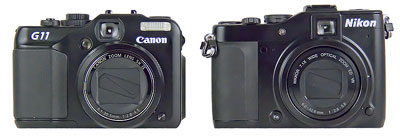
There's much to like about the new camera, though it is missing some G11-ness (positionable LCD and a dedicated ISO dial, for example). It's got a nice rugged build, has a very nice 920k dot 3" LCD, and is faster at focus than the P6000 it replaces. I would have preferred a dedicated ISO dial and the traditional exposure compensation button myself, but the alternatives on the P7000 work fine.
The Av/Tv button is just bizarre. Apparently a stray Canon engineer got into the Nikon facility or someone at Nikon noticed the Av and Tv nomenclature on the Canon cameras and decided that this too needed to be copied in some way, even if they didn't know what it meant. The button doesn't do Av (aperture priority) or Tv (shutter priority) at all. Nominally it just changes which command dial to use for controlling the aperture (or shutter). But it can be programmed for other things, like putting a histogram on the screen, so the button itself is useful, just not labeled particularly well. It's essentially another function button (there's also a dedicated function button, and a button whose function is changed via the dial that surrounds it--in other words a lot of user configurability, which is a good thing).
Unfortunately, there are steps backward from the P6000. First, the P7000 is bigger and heavier. No real need for that, the P6000 was a good size and sturdy enough in actual use. Second, the GPS is gone. To some that was one of the defining elements of the P6000, but it's history now. We've got yet another new battery (though at least you get a battery charger with this one). The tripod socket is offset from the lens center, a bad thing that shouldn't be in a high-end camera design, as it makes simple things like getting pano alignment tougher. And what's with a Long exposure noise reduction system that has settings of only Auto or On? Basically that means On most of the time, doesn't it?
Many of the old mistakes are still present, too. 80% view optical finder, NRW instead of NEF for a raw format, for instance.
We know Nikon did a tear down of the G series Canon's when they were contemplating this camera, but I have to wonder if they were accurately assessing why Canon made some of the decisions they made. The LCD, for example. There's a reason why it articulates and flips on the G11/G12: this protects it when you carry the camera as a pocket camera. That's a big miss by the Nikon engineers, especially since the LCD on the P7000 is so high rez to start with.
What people really want to know, though, is how it performs in terms of image quality. Short answer: about the same as all the other cameras using this 10mp sensor do: pretty darned well. ISO 400 is definitely usable. How much higher you'll tolerate depends upon whether you're using JPEGs with NR (or doing NR on raw files) and how much you like absolute edge acuity.
But image quality is the P7000's problem as well as its plus: my old S90 (now replaced by the S95) gets basically the same image quality, and it was a less expensive camera and much more portable. In fact, I kind of prefer the S90's controls better, too. And the G11 (now G12) basically give you the same size and build as the P7000 with the same image quality, but a few better details (that positionable LCD, for example).
Unfortunately, the big issue with the P7000 is lack of responsiveness when using raw. It takes almost three seconds to write a single NRW to my Class 6 card, and the camera isn't available to take another photo during that time (if you fire off bursts, you can get five images before the camera hangs, but then it'll be ~15 seconds before it comes back and allows you another frame).
The short story is that Nikon didn't move the bar. They simply got close to it.
I'll have a lot more to say about small cameras in the near future. More than a half dozen pretenders to the crown all sit on my desk taunting me to finish a review on them. But since so many of you have been asking about the new high-end compacts, I thought you'd want to know what I've found so far.