A number of you sent comments regarding my best guess for a D4 sensor. Everyone is going to be looking at three key attributes of that sensor (beyond how well it does video ;~): megapixel count, dynamic range, and high ISO capability. The D3x pushed the bar way up in megapixel count and I expect Canon's upcoming 1DsIV announcement to do the same. The D3s pushed the bar way up beyond where anyone expected it with high ISO capability.
The problem, of course, is that you can't exactly push both bars substantively higher simultaneously, and there are physical limits to one of the bars (electrons captured minus noise has caps on both ends). Megapixel count and high ISO capability are in conflict with one another, so if you push one aggressively, the other usually suffers.
I think that everyone believes that Nikon will add more pixels to their flagship camera. Even Nikon executives are on record as saying that we should see more pixels in the future. Unfortunately, trying to predict just where Nikon ends up with the D4 has two problems: (1) we don't have a lot of data points to plot with, and (2) the D3s sensor is above the noise progression trend we've seen through the history of sensors so far.
Canon on the other hand, has had a bit more history to draw data points and a plot line from (never mind the wizard behind the curtain or what he's showing you at the moment; I'm using a magical blend of numbers that I don't want to get bogged down in ;~):
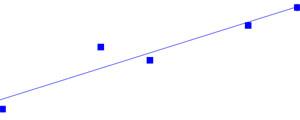
That line is interesting. It predicts that a 1DsIV in late 2010 would only make it to about 27mp and would only be marginally better in high ISO capability than the current 21mp camera (at best case, assuming that they make full progress on everything that line implies). Or Canon could produce a 32mp camera with almost the same noise levels (again best case).
So where will Nikon end up? Short of assuming that Nikon has some additional big D3s-like breakthrough, I end up having to guess that Nikon can only produce a moderate move forward in pixels by moving slightly backwards in high ISO capability. Whether the pixel count is 16, 18, or 20, these all seem to imply that the high ISO capability has to step back from where the D3s currently is, and that's going to cause a lot of grief with some Nikon pros, I think, many who have just latched onto a D3s because of its high ISO capability for their work (e.g. PJs and sports photographers). There just won't be enough time for the slow improvements we've seen over the lifetime of digital sensors to deliver D3s quality at anything approaching the pixel counts that most expect.
Thus, the danger is this: we move from having the best high ISO, fast frame rate camera (D3s) and the best high pixel count camera (D3x) to something that's a hybrid in between: neither as good as a D3s at high ISO nor as good as a D3x in resolution. Of course, that hybrid would be better than a D3s in resolution and better than the D3x in high ISO.
That last statement is what provoked most of the comments to me. The common denominator seems to be this: something else on that D4 had better be so compelling that they can overlook the compromise in the two key components of the sensor. Hey, I'll vote for modular, communicating, and programmable ;~). Indeed, that would solve the whole problem, wouldn't it? Because with a modular D4 you could get a D3s-like sensor module (noise control), a new D4 sensor module (hybrid), or a D3x-like sensor module (megapixels).
Not that I'm predicting that's what Nikon will do. But it is a clear answer to the dilemma facing Nikon. Whether they saw it in time is another story.