One of the constant questions I receive is this: "what do you think the D800 (or D400, or D4, or whatever) will cost when it comes out?" Anyone who's been paying attention should be able to answer that question.
Unfortunately, the answer isn't one that most people like: "about the same as the model it replaces cost when it first came out plus an adjustment for currency fluctuation."
The D700 had a MAP (minimum advertised price) of US$2999 when it came out. A D800 is likely to be roughly US$3499 when we finally see it. Nikon might price a little lower than that if they feel they need to be more competitive, but US$3499 is about the price you should expect. "But wait," some of you are saying, "the D700 was US$2399 for a long time." Sure.
The short history of DSLR pricing is already laden with data points to predict from. Typically a DSLR will fall about 25% from its launch to its liquidation sales. US$2399 is well within that range (20%). How fast the price falls and how far depends upon how popular the product was versus supply. We're seeing now just what happens when demand exceeds supply: the D700 price has risen since the Japanese earthquake because the plant that makes it shut down for a long period and is still under capacity, yet the camera is still popular.
Another common "but wait" statement I hear goes something like this: "the D7000 is so good Nikon doesn't need a D400, so the D800 will come in at the D300's price point."
Sorry, but that argument doesn't hold, either. When you have a range of product in a category (Nikon basically has seven DSLRs), you try to avoid huge price gaps, and you don't reduce your model lineup. Nikon is not going to price a D800 at US$1999 and a D4 at US$5499 with nothing in between. Plus see my first point: Nikon is not going to drop the D4 price to US$3999 or even lower.
The Nikon DSLR price points currently go something like this (at original MAP): US$699 (with lens, US$599 implied), US$799, US$1199, US$1699, US$2999, US$5199, US$7999. Yes, those get discounted somewhat in times of plenty and yen of weakness, and yes, there is a fairly large gap between the prosumer and pro product. But that gap is not going to get larger, nor is the pro product going to get cheaper. The basic curve looks like this, and it's a classical pricing curve:
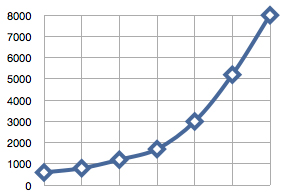
The tragedy in Japan has thrown a monkey wrench into things, though, not just in terms of Nikon's ability to produce several of the expected products, but also in terms of whether the yen can be protected from going still higher (it's taken G10 intervention to keep it from doing so since the quake due to the belief that Japan will have to repatriate yen back into the country to pay for the damages and rebuilding). Let's ignore that for a moment and pretend all is well in terms of manufacturing and yen (it will be some day, the only question is how soon). Here's about where things should stand sometime in early 2012:
- US$599 (discounted from US$699): D3100 with lens.
- US$699 (discounted from US$799): D5100, no lens.
- US$1099 (discounted from US$1199): D7000.
- US$1999 (new): D400.
- US$3499 (new): D800.
- US$5499 (new): D4s.
Figure that below that bottom we probably will have a mirrorless entrant and above the top we'll eventually have a D4x, and you've got the full interchangeable lens camera lineup. You'll notice that it has plenty of price points to keep everyone happy. To quote David Byrne "same as it ever was, same as it ever was, same as it ever was."