Let's jump over to the other expected camera in August, the D400. Why will there be a D400? For a number of reasons. Nikon's not going to terminate a product line unless it's completely uncompetitive, and the D100/D200/D300/D300s has been far from that over that cycle's life. The D300s (along with the D700) serves as a solid bridge between consumer cameras (D3100/D5100/D7000) and pro cameras (D3s/D3x). And if you look back in history, after the long D100/D200 time gap, Nikon's been consistently iterating this product at two year intervals. Guess what, the two years are up.
As a reminder, Nikon has the following price points at the moment: US$699, US$899, US$1199, US$1599, US$2699, US$5199, US$7999. Graphing them is interesting:
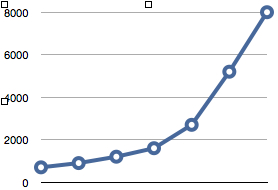
If you take the D300s out, you get a long gap between the first three and second three (jump from US$1199 to US$2699, and the first two are with lens, the last ones are not). There's a reason why this curve is regular and has more data points on the lower slope than the upper: price elasticity of demand: you'll buy more of the lower ones, fewer of the upper ones. By having models with smaller gaps between them, you can sometimes upsell someone to the next higher model. That's more important at the consumer end where the product is likely more of an impulse buy than at the pro end, where the purchase is a "need" buy. If the consumer gaps get too wide, upselling becomes impossible.
The sweet point these days for DSLRs is US$700-1500. If you look at the cameras stacked in that region (and the D300s was, too, until supplies got scarce), you find a remarkable array of very competent cameras. All those cameras sell decently and have high profit margins. Below that, the lower-end cameras also sell great, but have lower profit margins. Above the sweet spot the cameras sell in much smaller quantities and have very high profit margins.
So just on that alone, Nikon needs a D400. But there's also that competition. Canon already has the 18mp 7D. Sony, if we're to believe all the rumors, will have a 24mp A77 this fall. The Canon is priced in the D7000 to D700 gap. The Sony is expected to be priced at nearly the D7000 level. Even if you don't price the same as your competitors, you can't be a credible market leader if you have to say to customers "no, we don't have a camera like that." Especially in the sweet spot for DSLRs. Heck, even Olympus has a very nice camera that's in that gap (the E-5).
So timing, pricing, and competition say a D400 is due soon, and August is Nikon's traditional next launch window.
When I wrote earlier that the D400 would be 24mp, I got a lot of emails asking if I had written the number wrong (or if I was just plain crazy). Neither. First, we know that a 24mp DX sensor exists (or is about to exist in production form, from Sony). Second, back in 2003 I pointed out that the math said we'd get to about 24mp on DX before we exhausted the easy-to-see gains and started outshooting the best existing lenses. Third, at 16mp the Nikon would be trailing its two primary competitors in that market. Fourth, there's the "it's a mini D3x" notion that many will have when they see the D400. So, yes, we'll go there. 24mp is a done deal at some day in the future, so if that Sony sensor is good, the future is just about here. (Beyond 24mp I think things get much more fuzzy, and that's not just a pun on diffraction impacts.)
Now for the part that, I'm guessing, could be Nikon's surprise in August: binning. Binning isn't new. The D1 was a 10.4mp sensor that was permanently binned (four underlying photosites to one pixel). Nikon has played with binning since then, too, with the oddly binned D1x (two side-by-side photosites to one pixel). The answer to the "why 24mp question" suddenly becomes simple if you add binning to the mix: you potentially get a D400h and D400x all in one package. I do know that Nikon and Sony have been working on binning recently. That would make some sense for both stills and video and could lead to a jack-of-all-trades DX body that excels at everything: low noise, high resolution, video without artifacting, etc. And it would explain pursuing 24mp in DX and 36mp in FX.
But I'm only guessing at the binning thing. Without binning, and especially without BSI, we just have more pixels which means more data and power lines cluttering the sensor, meaning less light efficiency. Thus, even with the normal expected gains of a new generation of sensors, 24mp wouldn't really get us much further than the 16mp DX capabilities we already have, if any. Plus 24mp by itself really is pushing the full recording of diffraction into most image data.
With that, I'm going to take a pause on product speculation and jump back to something else for the rest of the week.