Nikon today announced three new Coolpix cameras. On first glance, two of the three should be of interest to this site's readers, as one is a high end Coolpix (P7100 replacement), and one is a programmable, communicating camera. First, the high-end camera.
The P7700 is the P7100 replacement. It features a 1/1.7" (small) BSI sensor with 12mp. It will sell for US$500 and be available in late September. I don't plan to get one. Why?
Someone at Nikon (and Panasonic) forgot to forward The Memo to the design group: the market has moved on. If you're going to build a compact camera for high end users, it needs a large sensor. Instead, the Junior Design Division was given the extensive task of: (1) removing the viewfinder; (2) putting in a real grip and making the front dial something closer to Nikon standards (they failed); (3) putting full swivel into the LCD; adding a mini pop-up flash; (5) making the lens a stop faster; and (6) adding a port to connect the GP-1 to. Oh sure, we get more pixels, but we always get more pixels, though usually more than 2mp. Overall, the big step forward for the P7700 over the P7100 is the one stop on the lens. This might have been a step forward except for the fact the RX-100 with it's 1" sensor has an f/1.8-f/4.9 lens: slightly faster at the wide end, slightly slower at the telephoto.
What virtually every P6000, P6100, P7000, and P7100 user wanted was one of two things: (a) a bigger sensor, ala the RX-100 and G1x which now completely bracket the P7700; or (b) put that flipping LCD and those sturdy dials on the V1. Voila, instant hit, either way. Instead, it's a swing and a miss. Coupled with the Android Coolpix (I'm getting to those), that's two strikes. One more and they're outta here.
Seriously, where Nikon seems to be taking Coolpix is into a strange land that wasn't exactly requested by users. I for one, am not even planning to test the P7700 at this point. Basically the name of that game is "if you liked everything the P7100 was, the P7700 is more of that." Heck, even the name is a bit strange. What does the P7700 have that justifies skipping the P7200, P7300, and P7400 numbers? Oh, right, the lucky 7 number that reinvigorated Sony's lineup. "You've got a double 7? We've got a double 7!" Whoo Hoo, great marketing guys. Now, get back to explaining why someone buys this over a RX-100 and G1x. Yep, one answer to that: cheaper (but it is less capable at the sensor).
Long time site readers know I asked for a large sensor Coolpix first in May of 2007 (pre D3). Don't believe me? Here's the article. At the bottom of that article are my specs. Turns out I designed a Canon G1x (only they gave me some extra pixels squeezed into a slightly smaller sensor). I'll note that quite a few people at the time sent me email that said I was dreaming, it could never be done. I'm guessing now that those were mostly Nikon Coolpix designers ;~).
And did I really see a video with the great wildlife photographer Jim Brandenburg pretending to be taking a picture with the P7700 by holding the folding LCD with two fingers and his right hand barely cradling the right side of the camera?
Now about that Android. The new Android camera is the US$350 Coolpix S800C (strange to be going backwards from S9xxx, S8xxx, S6xxx numbers, but when you just spray Coolpi all over the place, you're bound to have numbering issues; just prior to announcing the S800C, the NikonUSA listed 25 different currently available Coolpi ranging from US$89 to US$499, and if you're counting that's one Coolpix every US$15 price increment). Why this isn't an Axxx model, well, I guess Nikon thinks Android has "style" [S] (and is not "professional" [P]).
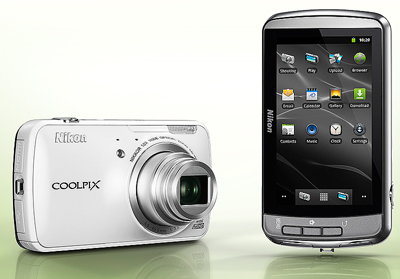
It looks to me that Nikon basically took, oh, a Coolpix S6300 (16mp, 10x 25-250mm equivalent, f/3.2-5.8) model, stuck Android inside, and raised the price US$150. Curiously, there's no indication of Android on the outside (someone was asleep in Google's marketing department when Android licensing terms were drawn up, or apparently never heard of "Intel Inside" [update: Nikon places a removable label that has the Powered by Android message on it]). As usual, Nikon's S terminology means the camera "looks like a soap bar." Since we're down to five buttons (including the shutter release and subtle on/off button), all that plastic is likely as slippery as a bar of soap, too. I wonder how that'll work, as you'll be doing a lot of poking and gestering at it. Basically this is the iPhone approach to cameras: grasp between thumb and other fingers on the left hand, poke/slide/gesture with the fingers on the right hand.
Okay, so it operates a lot like your phone. Only it's not a phone and duplicates all the functionality of your (old) phone while really adding only a bigger sensor and that wide-to-telephoto lens. The terrible thing for Nikon is this: if there's anything about the camera/phone (uh, I mean Android) integration that Nikon figured out that all the previous companies that tried this didn't, it'll just get copied. In a phone. Some of you may remember my suggestion:
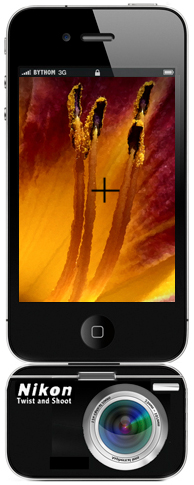
In this configuration there's a reason to have both a phone and a camera module: they don't duplicate each other, they augment each other (and yes, I would have allowed the camera to work independently of the phone, it would just work better when attached ;~). Ah, but then Nikon wouldn't actually be making the primary object, they'd be making an accessory. Ah corporate ego.
Those of you who cling to every word I write know what I think about Android (not a fan). With Android 4.1 popping out to most current Google devices, Nikon customers get version, wait for it, wait for it…version 2.3.3. It feels a bit like some demented version of the Seinfeld Soup Nazi: "No Ice Cream Sandwich for you. Next in line!" (No Honeycomb or Jelly Bean, either.) (Since my mom is probably reading this and scratching her head: Google names versions of Android after sweets, although I love sweets and can't remember the last time I had Honeycomb.) This isn't a moot point. If we're going to get apps developed for these new Coolpix cameras, the developers have to do it with API level 10 and NDK 5, not the current API level 16 and NDK 8. (Aside: one reason Nikon may be using 2.3 is that Google moved to multi-core support with later versions; if Nikon is using a cheap single core processor to run Android in the Coolpix, they may have tied their hands behind their back before they even started gathering rope.)
But let's step back further for a moment. Android, is, after all, an API. Meaning that, coupled with the camera's WiFi capabilities, they do indeed serve as Communicating, Programmable cameras, or two thirds of Thom's Holy Future Grail. I should like this Nikon Android, right?
Truth be told, I had a short argument with one of Nikon's engineers a couple of years ago about this very camera. I had just presented my CPM (communicating, programming, modular) business case to a group of Nikon executives and engineers. The question came back as to what program I'd write for a "consumer camera" (which turned out to be the S800c). My answer was quick and specific: hands free workflow. A consumer user wants to take images and have them magically appear where they want them (Facebook, Flickr, iPhoto, whatever), with the ability to jump in and override or augment them (and send the ones I marked via email to Person A in Address Book).
Likewise, even on the camera itself a consumer wants easier workflow. As I've noted earlier, a large percentage of compact camera users just keep their images on their camera (hey, Android has a Gallery app). Thus, finding them becomes important after the fact. The new Coolpix has GPS, WiFi, and Android, so…why doesn't the camera automatically generate "albums"? Via GPS we know where the camera has been (and we can look up the name of that location the next time we get to WiFi access). So let's consider several things that might have happened. You used the camera in the afternoon on a walk through Tokyo taking a photo every now and then. The fact that we have photos with time stamps and small distances between them via the GPS information suggests "walk." We have a starting and ending time (all were in the "afternoon"). We have a location (all were in "Tokyo"). So we create a photo album called Photo Walk 8/22/12 Afternoon in Tokyo. That evening we were at a wild party (reasonably fixed GPS) and took a lot of pictures. So we get another album called 8/22/12 Evening at Shin-Yurakucho Building. (Of course we allow the user to rename these, as desired.) And when I get on my home WiFi system, why wouldn't those albums be transferred automatically into iPhoto albums? (or Lightroom, or basically any of the popular software's definition of albums).
In other words, use programming to make things easy for the user. Reduce the workflow steps that the user needs to do.
The argument that I got into had to do with what "programs" I would create for such a camera. I think Nikon wanted to hear me say "Instagram." They wanted something splashy and fun, not something useful. In fact, I think if I had something splashy and fun, they might have given me a prototype to program.
But look at how they've implemented workflow on the new camera: via app. Now, does that app set up an easier workflow for me? Well, lets look at Nikon's own myPicturetown app: "When the my Picturetown app on Google Play is downloaded and installed, images captured with the S800c can be easily uploaded to my Picturetown. In addition, the app can be used to browse uploaded images, or to post a URL to a specific my Picturetown album to Facebook or tweet them on Twitter. It can also be used to view a list of my Picturetown albums, to rearrange albums using drag-and-drop operations, or to change their layout. Since images stored on my Picturetown can be accessed directly from the camera, users can easily view or share them with others, almost as if they were carrying photo albums around with them."
Did you note the "can be easily uploaded" in the description? As in "you can do a bunch more tapping within the app to move stuff from camera to the cloud." Not as in "you can configure your camera to send images where you want them." Workflow to Nikon is still a series of steps the user must complete mostly manually. Except now you just have to get your camera to a WiFi hot spot to do so instead of plug it into a USB port on your computer. Excellent improvement. Replace cable with air. Move app from computer to camera. Leave everything else the same.
One thing that will be interesting is whether a tangible market actually exists for app development for a specific camera model like this. iPhones and Android phones have healthy app markets because those devices sell in huge numbers. We're talking about more than 1 million such phones being activated a day. How many S800C do you think Nikon will sell in a year? A million? I have great fear that the economics of the situation will probably preclude tangible, deep, S800C applications. It's the Small Fish in Big Pool versus Big Fish in Small Pool problem for developers. But assuming Nikon sells a million Android Coolpi this year, how much do you as Big Fish in Small Pond have to sell your app for to survive? (Remember Google will be taking its cut.) And I can hardly wait to see ads on my camera display, can you?
Nikon has a long history of getting lost in technological dead ends and not making the technology perfectly useful. On my first trip to Japan back in the 90's I was introduced to two upcoming compact cameras: the first Coolpix. One of them had a pen-based interface (which was why I was shown it: I had just spent three years proselytizing pen-based systems for GO). This was the first of many Coolpix technologies in search of an actual use. More recently most of you probably have seen the Coolpix with projectors in them. Another nifty technology without solving a real user need. Heck, even WiFi escapes Nikon: the inexpensive WiFi dongle for the D3200 is completely useless to me, as it only currently communicates to Android devices. But even if I had an Android device, I'm not sure it really solves the user problem the right way. (Ironically, now we have a real brain buster: we can use a D3200 to communicate to a Coolpix. I suppose we also might get the ability to use the Coolpix to control the D3200--assuming Nikon's crack software team actually manages to get cracking something other than their knuckles.)
My sense is that an Android Coolpix is the same dead end as the Pen-based Coolpix and Projector Coolpix. A shame, because there is promise in having programmability in a camera. Especially when communications is also present.
As if all that weren't enough, we also have the new Coolpix S01, for which the press release gushes: "combining the simplicity of a cell phone with the advanced capability for expression of a camera." Say what? Send that sentence back to the translator, please.