So what happens if we just do a little historical plotting and a bit of extension of that plot?
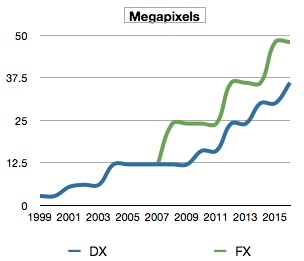
The D5 will be 48mp and the D9000 will be 36mp based upon regression analysis.
A lot of us have asked this question for some time now: at what point does the megapixel race stop? From a technical standpoint, not for a long time. There's actually nothing stopping us from creating 100mp+ FX bodies today (well, internal bandwidth might be a bit of a limiter and slow the camera down, but 100mp+ users are likely to be working slowly to start with ;~).
Back in 2003 I wrote about diminishing returns in increased pixel counts. I calculated that 24mp was about it for DX, and guess what, ten years later we're there. Go ahead, closely compare that 16mp and 24mp DX camera: did you get as much return as you expected from the pixel count increase? Curiously, we're beyond the equivalent to 24mp DX in other cameras from smartphones to Nikon 1's. The question is whether those increases are netting us truly useful gains any more.
The old 80/20 rule comes into play here. For 80% of you, no, 36mp DX probably won't provide any tangible gain over 24mp. The other 20% will always take a pixel count gain, because increased sampling always has some benefit, even if it doesn't show up in a major way. Plus there's always the croppers, who'll take any pixel increase in order to avoid buying and carrying the right lenses.
The camera makers thus have all kinds of hurdles in front of them, and more and more it's becoming clear that none of them has a clear vision about how to get past those hurdles: smartphones cannibalizing compact sales, diminishing returns on sensor progress, aging market for high-end cameras, need for instant workflow, and so on.
We've seen this game before in many different high tech areas, but one that the Japanese should be familiar with is High Fidelity audio equipment. HiFi went through some of the same lingoistic, numbers-driven marketing approach, too. And that all came to an end when most people realized that they couldn't hear the difference in the numbers. Digital audio put a big punctuation mark on that when it went commercial with the CD in 1982. Some of the bigger HiFi makers made that transition and got a few more years run, but eventually that pettered out (and was again disrupted by the iPod in 2001).
It's not that we don't have makers of audio equipment today, but the "build it and they will buy" mentality is completely gone now, as it will be for cameras. For an audio component maker to survive today, they have to have a vision, be low cost (to hold profit margins), high quality, quick to react to market changes, have a gimmick or trait they can market on, and be ready for more disruption (the recent wave of Bluetooth mobile speakers was another recent change that caught some small speaker makers unawares).
The camera market is ready for disruption. Where it will come from, I don't know. As I posted on sansmirror the other day, many of the camera makers seem a bit confused about what to do next. I'm thinking 36mp DX probably isn't the answer.