LEDE ON
The announce-arrive cycle appears to be getting longer. It used to be that new product announcements meant the product was already on its way to, if not already in the backrooms of, retail stores. In the late teens, that transitioned to be more announce, then ship within a month. With the Sony FX5, we’re now in the announce, then more than two months later it’ll show up era. Moreover, coupled with the fact that almost every new camera product of any note in the past five years has produced the notorious “demand is higher than expected” notice out of some sushi bar in Tokyo, I’d say that we’re fully in an era of Announce Disconnection. One has to wonder whether the industry is becoming so irrelevant that they have to send out smoke signals every once in awhile to remind folk gathered elsewhere that they’re still around. Nikon has managed three smoke signals so far this year. Pentax (see below) has taken up sending premature smoke signals.
——————————
News
OMDS Announces New Entry Camera
OMDS designers finally picked up their pens and designed a new camera. The OM System PEN is something between the older E-P7 and the original Olympus Pen-F, though it enters towards the bottom of the lineup at US$1000 (US$1300 with two lens kit).
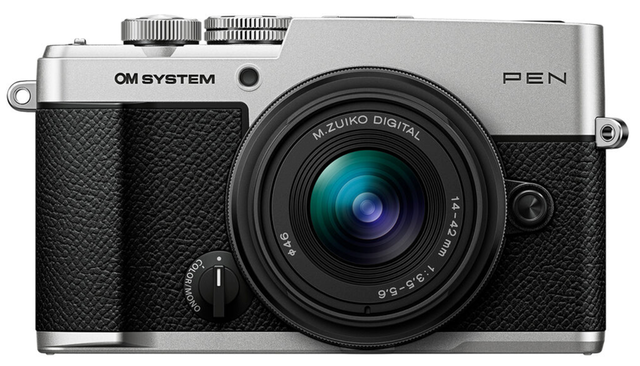
Many of the external attributes of the new camera appear to be a modernization of the E-P7 using the OM-5 II innards, though there are four significant changes: (1) the new body is weather sealed (IPX1 rating); (2) there’s now a rangefinder-style integrated 2.36m dot viewfinder; (3) the Rear LCD is now articulating instead of tilting; and (4) a new BLS-7 battery that produces 410 images (CIPA). At US$1000, the OM System PEN also bumps up in price from the E-P7 it appears to be replacing.
Inside we have a 20mp image sensor and TruePic IX (again, the OM-5 II versions). Stylistically, the new design does evoke some legacy look to it, particularly in the panda version of the camera. There’s a cleaner look to this camera than many previous OMs, and the slight bump grip on the right side is part of that. Personally, I don’t like the position of the ON/ViewMode switch, as that knob is in a place where it’s going to get accidentally triggered. I really don’t understand why the Japanese continue to make this type of design error, though it does keep the the controls all to the right and leaves the rest of the top plate clean.
The price places the OM System PEN well above the OM-D E-M10 Mark IV that’s still being sold, and well below the OM-3. My guess is that the E-M10 Mark IV has seen its last Mark. It never got the OM branding, and now it’s in a zone that would make it very difficult for a low-volume producer such as OMDS to make profits from.
It is interesting that this new camera also seems to indicate a shift in branding for the company. It’s not Olympus. It’s not OMDS the company, but cameras and lenses are now labeled as "OM System”. Some of this has to do with what trademarks OMDS inherited on the split from Olympus, but I’m surprised it took them this long to actually recognize the value in the OM portion and promote it to “system” status.
A couple of further thoughts…
First, I’m sure the PEN will sell quite well, particularly in Asia where the E-P models have done well. We’ll likely see a bump in OMDS unit volume again. But it essentially undercuts the OM-5 II, so I’d guess that we’re mostly going to see a shift of volume from one model to another, not a huge spike. The camera OMDS really needed is what I’ve been saying they should make for a decade now: a compact m4/3; Pen-styled, small, loaded with that computational tech provided by TruePic. That would have done more for their bottom line than the PEN we got.
I mention the OM-5II for a reason: it’s not much different in size (mostly the small viewfinder hump and bigger front grip), and uses the same technology. However, the OM-5II does sport some key differences: IPX53 rating, one-stop better IS, UHS-II support, 1/8000 mechanical shutter, and a slightly faster maximum frame rate. What it doesn’t have that the PEN has is the new battery, a new subject detection function, and a second Custom setting on the Mode dial. I’d rather have the OM-5II than the PEN, I think.
Second, the current omsystem.com Web site page for the PEN has a lot of images on it that feel crunchy or uncompelling to me. The redhead, for instance, has blown skin on one side of her face and overly pink skin on the other. Focus is on her teeth, not her eyes. It’s just not a portrait I’d be highlighting. But other images on that page seem dull or incorrect, as well, and skin tones are all over the place. Perhaps OMDS thinks they’ll illustrating Profile Control, but if that’s what the results are, why would I want it?
——————————
News
A Week Full of Lenses
Besides Nikon’s Development Announcement of nine Z CINEMA lenses, one of which (50mm t/1.9) was on display at IBC (International Broadcasting Convention) this week, we also got a number of literal lens launches:
- OMDS introduced another new (third) version of the 14-42mm f/3.5-5.6 R kit lens with the PEN, now moving to the OM Syystem branding from the original Olympus one. In addition, the lens is now IPX1 rated, and can focus down to 5” (13cm), which gives it a maximum magnification just under 1:4.
- Sigma announced the much-leaked 85mm f/1.2 Art lens, as well as surprise 20-60mm f/2.8-4 Contemporary lens. Both lenses show up for the Sony E as well as the L-mount. The 85mm sells for a reasonable US$1600, and has all the features you’d expect from an upscale portrait lens. Up front you’ll need 82mm filters, though. The 20-60mm f/2.8-4 clocks in at US$850, and the MTF values show why it’s at that price and labeled Contemporary, as it fits more of a consumer than prosumer spec. It’s a reasonably compact lens
- Sony announced the FE-mount’s first fisheye zoom, the 8-14mm f/3.5G (US$1600). Very similar to the Nikon F-mount 8-15mm, this lens produces full frame circular fisheye effects at 8mm, and full frame 180° diagonal coverage at 14mm. Filters are done via a rear gel filter holder, as the front optic is a bit bulgy for filters. The most intriguing part of the press release was the photo that shows two Sony full frame box cameras mounted side-by-side, each with an 8-14mm out front. The implication here is for some sort of 3D virtual reality capture, though I don’t know how you’d get them exactly paired in terms of focus/focal length except perhaps at extreme ends of the focal range (and using the Zoom Lock buttons) and hoping the focus is close enough.
- TLS joined the “re-house NIKKOR AI/AI-S lens” crowd with nine lenses that use the original NIKKOR glass, but puts them in new precise and video-friendly casing (0.8 MOD rings, big bright lettering, along with an Arri or PL mount). So we get 15mm t/3.9, 20mm t/3, 24mm t/2.2, 28mm t/2.2, 35mm t/1.5, 50mm 5/1.3, 55mm 5/1.3, 58mm t/1.2, 85mm t/1.5, 105mm t/1.9, and 135mm t/2.1 options. You can have your own lens re-housed for £3950 or just buy a fully done set for US$50,000 should you not have a set of old NIKKORS laying around.
——————————
News
Pentax Stops Making DSLRs to Make DSLRs?
In a 100% confusing official announcement, Pentax (Ricoh) announced that the current K-mount camera lineup is ending. To be replaced by a “new SLR concept” that will support the K-mount that will “take time” to develop. A lot of non-specifics in that statement.
The announcement has all kinds of head scratchers in it, some I’m sure intentional, some not. For instance, rather than using the term DSLR, they use the term digital SLR. I suspect that’s because what comes next is mirrorless, and the term they use is sloppy enough to include both DSLR and mirrorless. Then comes the confusion caused by “RICOH IMAGING will continue…” versus “next stage of PENTAX…” I sense a rebranding coming, perhaps similar to the OM System Pen, e.g. Ricoh Pentax or maybe even just Ricoh K.
The K-mount itself is confusing in the announcement. That the future cameras not yet designed “...will leverage the K-mount legacy...” is different than saying “we’ll continue to use the K-mount.” As for “allow more people to enjoy the process of photography itself,” in several places the press release alludes to “an entirely new concept,” whatever that might be. FWIW, most other sites are claiming that the press release says that Ricoh is developing new Pentax DSLRs. That’s not the way I read it. Indeed the headline is “PENTAX Digital SLR Cameras Aim for a New Stage.” The word usage is specifically vague enough that what appears next may not be what we’d call a DSLR.
As for the discontinuation of current Pentax DSLRs—or should I say DSLR, as only the K1- Mark II still seems to be available—no specific time was given for that, either: “we will discontinue…” doesn’t indicate that they have already done so, as some sites are reporting.
In essence, Ricoh/Pentax has basically said they’re going on a sabbatical to do some thinking and tinkering and try to reimagine themselves. Don’t bother to contact them, they’ll send you a postcard or two while they’re away.
——————————
News
Apple Introduced Their New Cameras Phones
Seems everyone was ready to get back to work after the Labor Day holiday. Apple introduced the iPhone 18 Pro (and Pro Max) with one of the big features being an f/1.48 lens on the main camera (24/48mm) with a user-controllable aperture diaphragm (down to f/4), new “pro controls,” additional photo styles, true subject focus tracking, 4K timelapse, front-and-back simlutaneous capture, and, not really played up in their announcement stream: reference image, Apple’s authenticity capability (only on the main camera).
Actual focal lengths (not the computed ones) are 13mm, 24mm, 48mm, 100mm, and 200mm in full frame equivalent values, though only the 24/48mm lens is fast aperture, using a larger image sensor (2.44 micron quad-pixel versus 1.4 micron quad-pixel). Apple outlines this as .5x, 1x, 2x, 4x, and 8x zoom, keying off 24mm (effective) being the focal length that’s based upon. Note that only the main (24/48mm) camera has changed from the iPhone 17 in terms of sensor and lens, the rest remains the same as on the iPhone 17 Max. Surprisingly, both the 18 Pro and 18 Pro Max versions have the identical new camera module, which was not what was rumored. The primary differences between those two phone models comes only in screen size (6.3 or 6.9”) and battery capacity.
The new iPhone Duo, which is Apple’s new foldable smartphone, runs just main and ultra wide camera modules to provide 13-48mm (effective), or 2x in Apple’s rounding. One thing the Duo has that the 18 Pro models don’t is “Smart Take,” where the phone determines when to take snaps while you’re away from the camera posing. Think of it as Smarter Self-Time mode, where the image isn’t taken at a specific time interval, but rather when the phone’s analysis says that the scene in front of it has stabilized. The other camera difference in the Duo is that it features an under-display camera for FaceTime calls when using the larger, folded out display.
It’s of course difficult to assess exactly how much, if any, image quality may have improved with this generation of iPhone without actually getting one and putting it to a real test, which I intend to do.
——————————
Explainer
What is LOFIC?
You may have seen that acronym appear recently in some articles about smartphones. Honor, Huawei, and Xiaomi have all introduced products with that technology in the image sensor, and Apple is rumored to be next (iPhone to be introduced in 2028). Current smartphones appear to be using Sony’s LYT-838 (50mp) or LYT-910 (200mp) sensors, but Apple’s own design may end up being produced by Samsung. Moreover, Apple’s design is a stacked image sensor that is said to incorporate image processing and noise reduction in the added layer.

The acronym stands for Lateral Overflow Integration Capacitor and is the long-awaited fill-the-photosite-and-then-fill-it-again technology some have been wanting for years. In essence, each photosite has two storage capacitors, a small one that keeps filling, and a larger one that collects what the smaller one keeps obtaining. Ironically, the overall full well capacity of a photosite goes up by using this approach, even though the initial storage well may be smaller (to make sure that it is fully used and gain can be kept low). The values of both capacitors need to be read, so you also need some sort of gain blending going on downstream.
Note that the real benefit being gained is typically more highlight detail. When you see reports of expanded dynamic range attributed to LOFIC, the noise floor is not really changing in the current chips. What is changing in the current implementations is the saturation point of the image sensor is being raised.
Currently, the only available LOFIC image sensors are all four adjacent pixels of the same color, though these are arrayed in a Bayer-type pattern. Moreover, these sensors cost more to produce and use more power than the simpler single-capacitor design. But the real potential here lies in getting HDR-like results without resorting to additional images, and the ability to handle high contrast scenes without blowing out the pixel data.
So this applies to large-sensor cameras, too, right? I’m not convinced of that, certainly not in the short term. Our large sensor cameras have very large full well capacities compared to the chips being used in smartphones. If you’ve tried HEIF in your camera and clicked on Adobe’s HDR button while viewing on a Retina display (HDR-capable), you may have been surprised to find that you already have a huge amount of highlight information that isn’t being used effectively in 8-bit JPEG images (between one and two stops, typically). Fundamentally, though, we still have the problem of fitting large capture dynamic range into displays/prints that are lowest common denominator. We still face the issue of where do we put any extra dynamic range and how do we display it, and the algorithms for doing that can produce results anywhere from crude (obvious) to decent (not obvious).
The real issue behind extended dynamic range is this: are you displaying your photos in ways that will use it? All of Apple’s current devices and displays can show more dynamic range than a JPEG can really show. Your 4K television probably can, too, as almost all recent ones are HDR-capable.
——————————
Commentary
Right Thumb On/Off
I’m suddenly seeing cameras that are turned on by something on the back right-top deck of the camera. The OM System PEN (above) is one of those, but more have and will appear. I get the design impulse: the user brings the camera up to their face and it’s off, the right thumb is in a position to quickly trigger it on. But it’s also in a position to quickly trigger it off accidentally.
Sure, at least one of those that I’ve used has a very stiff switch that’s not easy to move, but that switch will get used a lot, and generally the level of switches Tokyo has been using get less stiff with use.
There’s no perfect place to put on/off. On the Nikon’s its done with a ring around the shutter release, and I have on rare occasions managed to trigger that off when I didn’t want to. On many smaller cameras it’s instead a small power button near the shutter release, and often not recessed enough or distinguishable enough from other buttons; at least on the Nikon ZR the button is way over on the side of the top plate where I’m not interacting with anything.
The fact that Tokyo keeps experimenting with new controls and locations for on/off indicates that they know that we users have sometimes accidentally triggered a camera off just when we wanted to take a picture, or stuffing the camera in the bag turns the camera on and uses battery while we’re not using it. It’s a really tough design issue, as I’m not sure we’ve yet seen the “perfect” approach. But this does speak to those that keep switching cameras and brands: you’re not likely to build an on/off skill that becomes second nature, which means some day you’ll miss a photo or exhaust a battery or have settings changed accidentally because the camera was on when it was being roughly handled.
——————————
Commentary
<tk>
<tk>